

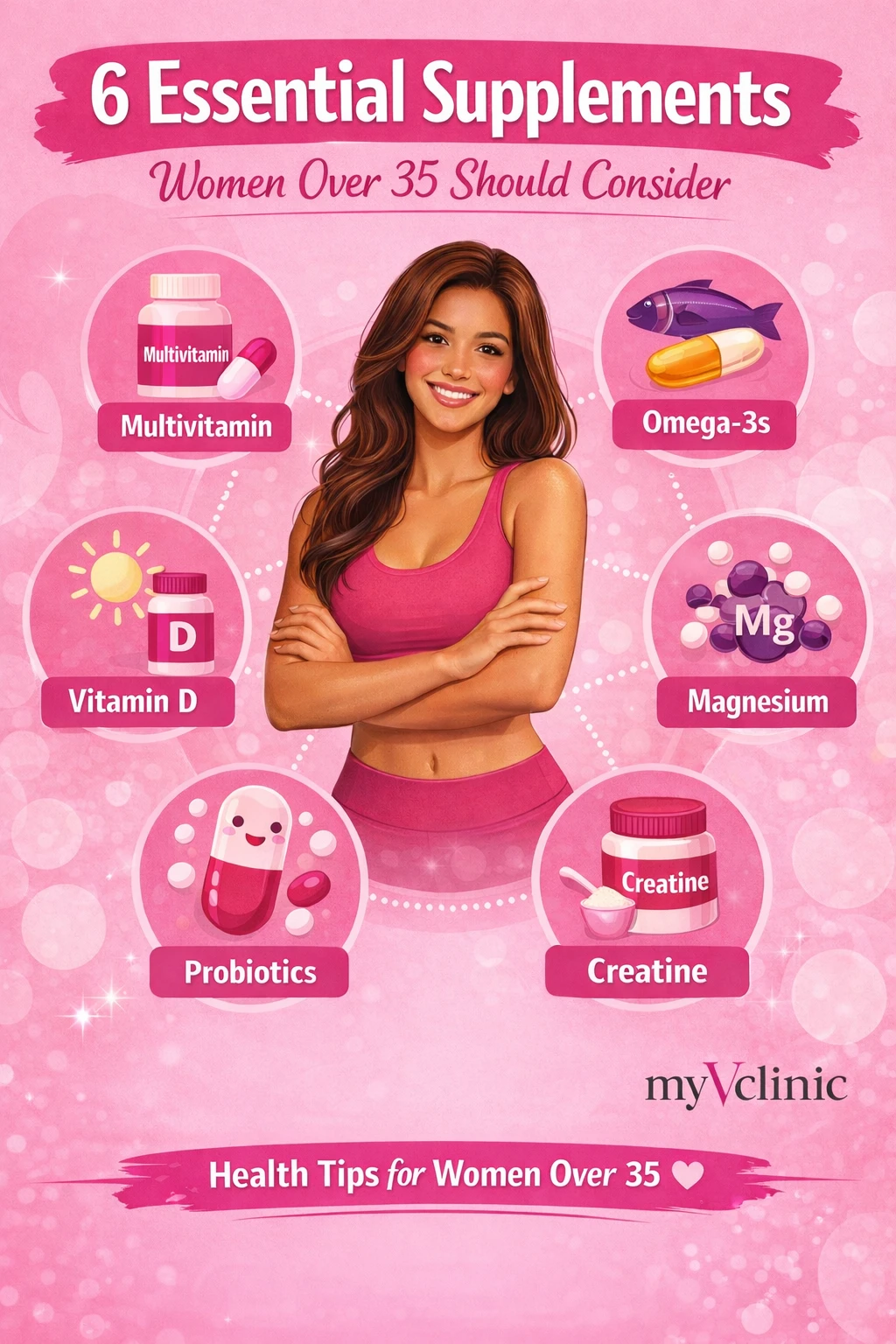
6 Essential Supplements Women Over 35 Should Consider
Essential Supplements Women
Hormone, Metabolism and Longevity Support
You are not imagining the shift.
Somewhere between 35 and 45, your body starts responding differently.
Sleep gets lighter.
Workouts feel harder to recover from.
Stress lingers longer.
Your mood feels less stable.
Body composition changes even if your habits have not.
This is not weakness.
It is biology.
Hormones begin changing long before menopause. Muscle mass begins declining earlier than most women are told. Insulin sensitivity slowly drifts. Nutrient absorption changes. Chronic stress compounds everything.
And here is the part most women do not hear:
Modern life increases nutrient depletion.
You are not living in an ancestral environment. You are not eating wild caught fish three times per week. You are not harvesting vegetables from mineral rich soil. You are not waking with the sun and sleeping eight uninterrupted hours in complete darkness.
You are managing careers, families, devices, stress, deadlines, environmental exposure, indoor work, and a food system that is not what it used to be.
Supplements are not magic.
But strategic supplementation can support physiology when used correctly.
At My V Clinic, we do not recommend random stacks. We test. We personalize. We monitor. Supplements are tools that support hormone balance, metabolic stability, bone density, cognitive resilience, and long term health.
Below are six foundational supplements women over 35 should consider, based on physiology, research, and clinical experience.
1. A High Quality Multivitamin and Mineral
The Problem
After 35, several trends converge:
• Digestive efficiency may decline
• Stress increases nutrient demand
• Soil mineral depletion affects food density
• Hormonal shifts increase metabolic strain
Common deficiencies we detect:
• Vitamin B12
• Folate
• Zinc
• Iodine
• Iron
• Vitamin D
• Magnesium
A multivitamin is not a replacement for food. It is baseline coverage.
A randomized controlled trial published in The American Journal of Clinical Nutrition demonstrated that daily multivitamin use improved global cognition and episodic memory over two years compared to placebo.
This supports the concept that baseline micronutrient adequacy influences brain aging.
Clinical Insight
Iron should never be added blindly. Ferritin testing is essential. Many women over 35 have low ferritin even when standard labs appear normal.
Personalized hormone support, weight loss, and aesthetic care for people ready to feel like themselves again.
2. Omega 3 Fatty Acids
The Problem
The modern diet is heavily weighted toward omega 6 fats from processed oils.
Historically, humans consumed a far more balanced ratio.
Omega 3 deficiency is associated with:
• Inflammatory imbalance
• Mood instability
• Skin dryness
• Cardiovascular strain
• Cognitive decline
EPA and DHA are the biologically active forms.
Plant based ALA does not convert efficiently in many individuals.
Why It Matters After 35
Inflammation becomes more metabolically expensive with age.
Omega 3 adequacy supports:
• Brain health
• Hormone signaling
• Skin integrity
• Joint comfort
An omega 3 index test provides precision rather than guesswork.
3. Vitamin D3
The Problem
Vitamin D functions as a hormone.
It influences:
• Immune regulation
• Bone density
• Mood
• Muscle strength
• Estrogen and testosterone balance
Winter in Colorado reduces UVB exposure significantly. Indoor lifestyles further limit production.
An estimated one billion people worldwide are deficient.
Optimization Range
Lab reference minimums do not always equal optimal function.
Vitamin D3 is preferred over D2.
It should be taken with fat and monitored through labs.
4. Magnesium
The Problem
Magnesium participates in over 600 enzymatic reactions.
It supports:
• Nervous system regulation
• Blood sugar balance
• Sleep quality
• Muscle recovery
• PMS symptom reduction
Modern stress increases magnesium loss.
Caffeine, alcohol, and high sugar intake increase excretion.
Deficiency may show up as:
• Muscle twitching
• Anxiety
• Constipation
• Headaches
• Insomnia
Magnesium glycinate is commonly used for nervous system support.
RBC magnesium testing can provide deeper insight than serum alone.
5. Probiotics
The Problem
Gut health affects:
• Estrogen metabolism
• Immune balance
• Mood signaling
• Inflammation
• Nutrient absorption
Dysbiosis increases with:
• Antibiotic exposure
• Processed foods
• Chronic stress
• Low fiber intake
A targeted probiotic may help restore balance, but strain selection matters.
In some conditions, probiotics must be introduced carefully.
Dietary fiber diversity remains foundational.
6. Creatine
The Problem
Muscle mass begins declining in the 30s.
Loss of lean mass contributes to:
• Insulin resistance
• Reduced metabolic rate
• Increased fracture risk
• Reduced resilience
Creatine is one of the most studied supplements available.
It supports:
• Lean muscle preservation
• Strength gains
• Glucose regulation
• Cognitive resilience
For women entering perimenopause, preserving muscle is preserving metabolic health.
Creatine monohydrate remains the most researched form.
Kidney function should be evaluated prior to supplementation.
The Order Matters
Supplements do not replace:
• Protein intake
• Resistance training
• Sleep
• Stress regulation
• Sunlight exposure
The proper sequence:
Test
Interpret
Personalize
Monitor
Blind stacking is guessing.
Precision support is medicine.
Frequently Asked Questions
• Do I need all six supplements?
Individual testing determines what you personally need. Not every woman over 35 requires all six.
• Can I get everything from food alone?
In theory yes. In modern environments with soil depletion and high stress load, it is often difficult to consistently reach optimal levels.
• Is creatine safe for women?
Yes, when appropriately dosed and medically monitored. It is one of the most studied supplements available.
• Should vitamin D be taken year round?
That depends on your lab values, seasonal sun exposure, and individual absorption patterns.
• Is magnesium best taken at night?
Often yes, especially for sleep support. The form and dose matter.
• Are probiotics necessary for everyone?
No. Gut health should be evaluated based on symptoms and, when appropriate, testing.
• Should I supplement iron preventively?
No. Ferritin should be tested before supplementing iron to avoid excess accumulation.
• Are plant omega 3 sources sufficient?
Conversion from plant forms to active EPA and DHA varies widely. Testing helps determine adequacy.
• Can supplements fix hormone imbalance alone?
No. Supplements support physiology but do not replace comprehensive hormone evaluation and care.
• How do I know what I personally need?
Comprehensive lab testing and clinical evaluation provide the most accurate guidance.
This content is for educational purposes only and does not constitute medical advice. It does not diagnose, treat, cure, or prevent any condition. Always consult a qualified healthcare professional regarding symptoms, medications, or treatment decisions.
Related Reading
This content is for educational purposes only and does not constitute medical advice. It does not diagnose, treat, cure, or prevent any condition. Always consult a qualified healthcare professional regarding symptoms, medications, or treatment decisions.