

Protein and Muscle Health & Why It Matters
Protein and Muscle Health
If this is your first time hearing this, understanding the role of protein in muscle health can feel like trying to read a foreign language. But here’s the straight talk: protein isn’t just another buzzword tossed around in gym locker rooms — it’s a foundation of how your body builds, maintains, and repairs muscle tissue. Whether you’re a seasoned athlete, someone managing age-related muscle loss, or simply trying to maintain strength as you grow older, what you eat — especially how much protein you consume and when — has a direct impact on your muscle health.
For many people, the focus is on how much protein they should eat. But experienced clinicians and researchers have shown that protein’s real value lies in how it works with your body’s physiology, particularly in stimulating muscle protein synthesis (MPS). This process is essential not just for recovery after exercise, but for preserving muscle mass as you age and helping your metabolism stay efficient.
In this post, we’ll break this down clearly, using evidence from reputable sources like PubMed and clinical research, including the guidance of high-quality studies such as this one on protein timing and distribution in adults: https://pubmed.ncbi.nlm.nih.gov/35187864/ .
You’ll walk away with:
-
A grounded understanding of protein’s role in muscle health.
-
Specific recommendations for daily protein intake and timing.
-
Practical tips, examples, and myth busting.
-
Real-world evidence you can trust.
Let’s get into it.
What Is Protein and Why Does It Matter?
Protein is one of the three macronutrients — alongside carbohydrates and fats — that your body needs in large amounts every day. Unlike carbs and fats, which primarily provide energy, protein plays a structural and functional role in nearly every cell of your body.
Protein is made up of building blocks called amino acids. There are 20 amino acids your body uses to build the proteins that make up muscles, organs, enzymes, hormones, and immune cells. Nine of these are called essential amino acids (EAAs) because your body can’t make them — you have to get them from your diet.
Here’s why that matters for muscle health:
-
Muscle tissue is constantly being broken down and rebuilt. This cycle is called muscle protein turnover.
-
To build and repair muscle, your body needs a supply of amino acids.
-
Protein from food provides those amino acids.
If you aren’t providing enough amino acids, your muscles don’t get the materials they need — and over time, that can lead to muscle loss, reduced strength, and slowed recovery.
How Much Protein Do You Really Need?
You’ve probably heard that “0.8 grams of protein per kilogram of body weight” is the recommendation. That’s true for general health, but when the goal is optimal muscle health, especially for adults who exercise or are middle-aged and older, that number is just the starting point.
Personalized hormone support, weight loss, and aesthetic care for people ready to feel like themselves again.
Evidence-Based Intake Targets
Several clinical studies and reviews show that higher protein intakes are associated with greater muscle mass and better muscle maintenance, especially when paired with resistance training.
Most experts now agree that:
-
For healthy adults, 1.2–1.6 g/kg/day supports muscle health better than the old 0.8 g/kg standard.
-
For older adults (above 60), or those with muscle loss concerns: 1.5–2.0 g/kg/day may be more effective.
For example, a clinical study on protein intake and muscle function noted how distributing protein evenly across meals and increasing total daily protein supports better muscle synthesis and physical performance. The timing and distribution — not just the total amount — matter significantly. https://pubmed.ncbi.nlm.nih.gov/35187864/
What That Looks Like in Real Life
Let’s take a 70-kg (154 lb) adult:
-
Moderate goal: 1.2 g/kg × 70 kg = 84 g protein/day
-
Higher goal: 1.6 g/kg × 70 kg = 112 g protein/day
-
Older adult with muscle maintenance concerns: up to 2.0 g/kg × 70 kg = 140 g protein/day
That’s a far cry from the “one shake a day” myth. The best results come when protein is spaced strategically across meals.
Why Timing and Distribution Matter
If your protein is all in one meal — say, dinner — your body gets a big pile of amino acids all at once. It’s like trying to pour a five-gallon bucket into a one-gallon cup: most spills over and goes to waste.
Muscle protein synthesis peaks when your body receives about 25–40 grams of high-quality protein in a sitting. After that, additional amino acids are used less efficiently for muscle building and more for energy.
Meal Strategy for Muscle Health
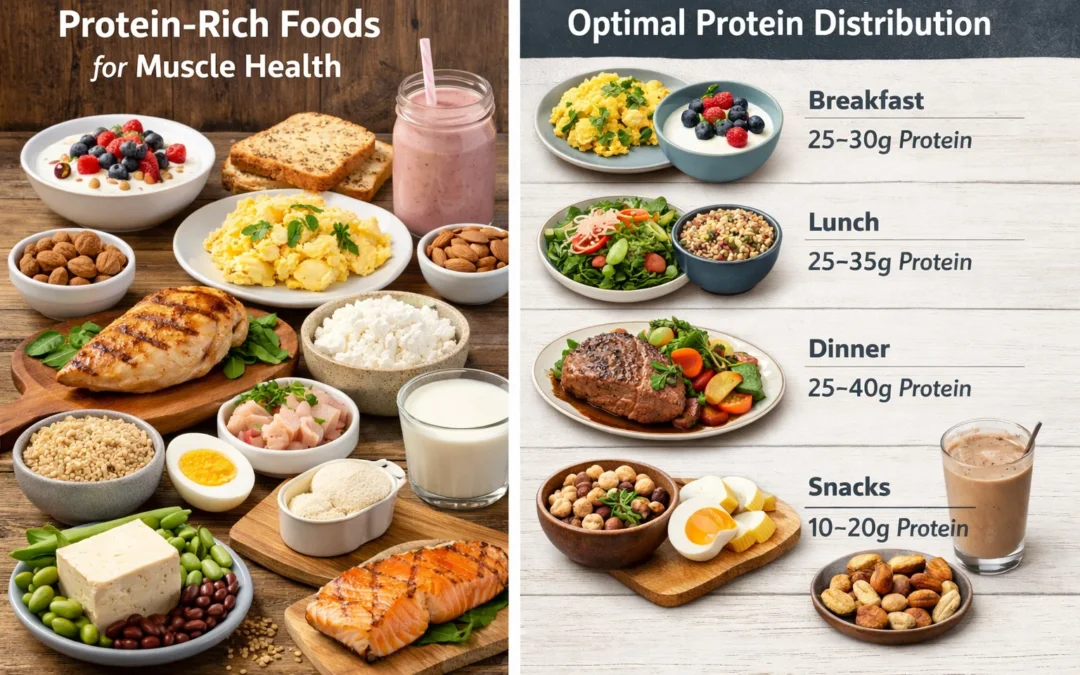
Aim to spread protein across your day like this:
-
Breakfast: 25–35 g protein
-
Lunch: 25–35 g protein
-
Dinner: 25–40 g protein
-
Optional snacks: 10–20 g if needed
This approach keeps your body getting regular amino acid supplies — the way it was meant to work.
What Is “High-Quality Protein”?
Not all proteins are created equal in terms of muscle building potential.
High-quality proteins:
-
Contain all essential amino acids.
-
Are rich in leucine, the key amino acid that activates muscle protein synthesis.
-
Are easily digested and absorbed.
Examples:
-
Animal sources: eggs, whey protein, dairy (Greek yogurt, cottage cheese), beef, chicken, turkey, fish.
-
Plant sources (paired wisely): soy, quinoa, beans + rice combinations, pea protein.
For many people, a mix of sources works best — especially if you’re plant-forward but still focused on muscle health.
The Role of Leucine
Leucine is the signal that tells your muscle cells to start building. Think of it as the “starter motor” for muscle protein synthesis.
About 2.5–3.0 grams of leucine per meal is a practical target to stimulate the muscle-building process. That’s typically satisfied with:
-
~25–30 g of whey or animal protein
-
~35–45 g of mixed plant protein
The point? You don’t need massive total protein if each meal is designed right.
Protein and Exercise: A Team Sport
Protein alone won’t make you stronger — but without enough protein, your hard work in the gym won’t pay off as well.
Resistance Training
Lifting weights or doing resistance exercise is the signal your body needs to say, “We need more muscle!” Protein then provides the materials to do it.
Pairing resistance exercise with adequate protein:
-
Boosts muscle protein synthesis
-
Speeds recovery
-
Improves strength gains
-
Reduces injury risk
Most people do best with 2–4 resistance workouts per week, each followed by protein within 30–60 minutes of finishing.
Special Considerations: Aging and Muscle Health
As we age, the body becomes less responsive to protein — a phenomenon called anabolic resistance. This means older adults may need more protein than younger people to achieve the same muscle-building effect.
This is why:
-
Older adults benefit from higher daily protein
-
Protein should still be evenly distributed
-
Resistance exercise becomes even more critical
Studies find that when older adults hit both targets — resistance training plus high-enough protein — they can significantly slow or even reverse muscle loss.
Common Myths About Protein
Myth #1: You Need Protein Powder to Build Muscle
Not true. Whole foods like eggs, lean meats, dairy, and legumes work just as well. Protein powders are a convenient option when whole food isn’t available.
Myth #2: More Protein = More Muscle Automatically
If you eat 200 g of protein in one sitting but don’t exercise or distribute it, you won’t maximize muscle growth. Balance and timing matter.
Myth #3: Plant Proteins Can’t Build Muscle
They absolutely can — but plant proteins often need complementary pairing to ensure a complete amino acid profile (e.g., rice + beans). Whole-food plant proteins like soy and quinoa are complete proteins on their own.
Practical Tips for Daily Protein Success
Make this easy with habits that fit real life:
-
Start with protein at breakfast: Eggs, Greek yogurt, cottage cheese, or a smoothie with whey/plant protein.
-
Pack protein into lunch: Grilled chicken, tuna salad, turkey sandwich on whole grain, tofu stir-fry.
-
Aim for a protein-forward dinner: Beef, salmon, pork, lentils, beans, or tofu.
-
Use snacks wisely: Nuts, cheese sticks, hummus with veggies, a protein shake.
-
Plan meals in advance: If your day gets busy, prepping food ahead means you stay on track.
-
Track meals briefly: Use an app or simple journal to ensure you hit your protein targets.
Safety, Kidney Health, and Protein
Higher protein diets are safe for most healthy adults. People with pre-existing kidney disease should discuss protein targets with their clinician. For most people — even older adults — higher protein can support better outcomes when balanced with overall nutrition.
Real-World Success Stories
Many clients report:
-
Faster recovery after strength workouts
-
Leaner physique and better muscle definition
-
Higher daily energy
-
Greater confidence in physical function
These are not magic bullet changes — they are the result of consistent protein intake, intelligent meal timing, and strength-focused exercise.
Conclusion
Protein isn’t just a nutrient — it’s a tool. A properly used tool that supports your muscles, your strength, and your long-term health. With the right amount, the right timing, and the right exercise, you can preserve and build muscle at any age.
If you’re wondering where to start, a simple first step is to ensure 25–35 grams of protein at each meal, spread throughout the day, from quality sources. Pair that with regular resistance exercise, and you’re on the right path.
The science supports it. Clinical research supports it. Your body responds to it.
Start today — your muscles will thank you.
Related Reading
This content is for educational purposes only and does not constitute medical advice. It does not diagnose, treat, cure, or prevent any condition. Always consult a qualified healthcare professional regarding symptoms, medications, or treatment decisions.