

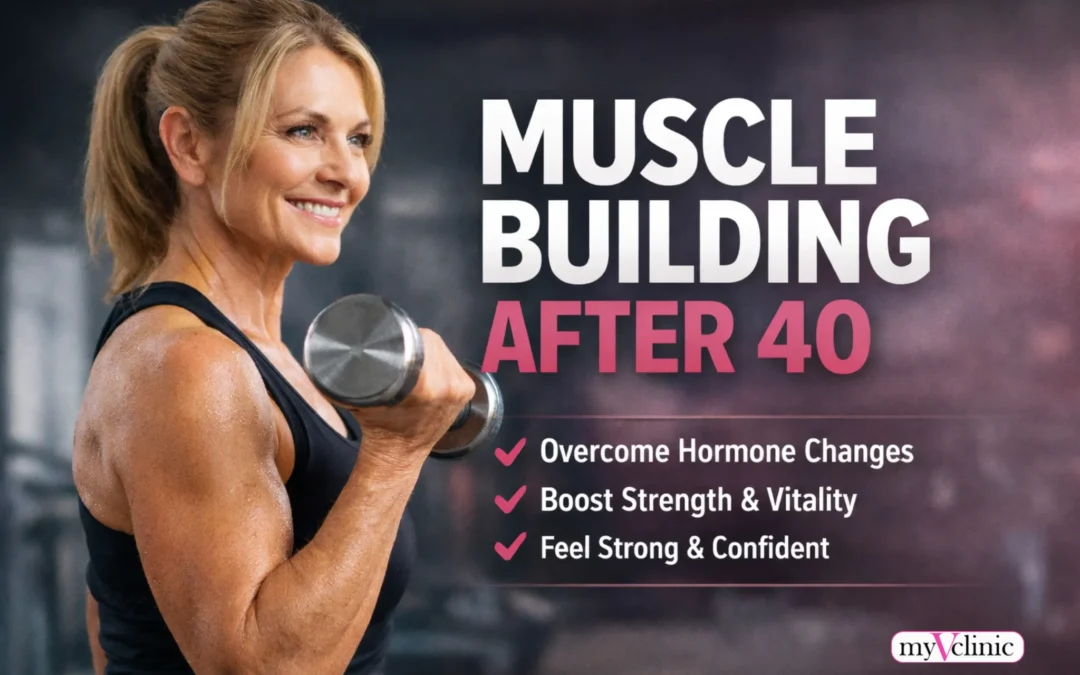
Muscle Building After 40
Muscle Building After 40
If you are a woman in Thornton in your forties or fifties and you feel like your body changed without asking your permission, you are not imagining it.
You may be working out consistently.
You may be eating cleaner than you ever have.
You may be trying harder than you did in your thirties.
And yet your muscle tone feels softer. Your recovery is slower. The scale does not reflect your effort. Your midsection looks different. Strength gains stall.
It can feel confusing. Frustrating. Even discouraging.
You are not lazy.
You are navigating a biological shift.
Muscle Building After 40
Muscle Building After 40 is not only possible. It is critical for long term health.
What many women are experiencing in midlife is not failure. It is physiology. Estrogen, progesterone, and sometimes testosterone begin fluctuating during perimenopause. These hormonal shifts influence muscle repair, sleep quality, insulin sensitivity, inflammation, and recovery.
The rules that worked in your twenties do not work the same way now.
This article will unpack what is actually happening inside your body, why traditional “eat less and do more cardio” advice fails in midlife, and how resistance training, protein optimization, and hormone awareness work together to support lean muscle development.
By the end, you will understand:
• Why muscle loss accelerates after 40
• How hormone shifts affect muscle recovery
• Why protein intake matters more now
• What a structured, sustainable strategy looks like
• When guided hormone care may support your efforts
At My V Clinic in Thornton, Colorado, we work with women 35 to 55 navigating exactly this transition. Our focus is educational, responsible, and personalized. The goal is not extreme physique goals. The goal is strength, metabolic health, and longevity.
Muscle is not about appearance alone.
Lean muscle:
• Supports bone density
• Protects against insulin resistance
• Improves balance and joint stability
• Reduces frailty risk
• Supports metabolic flexibility
• Improves long term independence
Muscle Building After 40 requires strategy, not punishment.
The Problem
The visible problem is softer muscle tone and stubborn fat distribution.
The hidden problem is outdated advice.
Many women were taught that the solution is:
Personalized hormone support, weight loss, and aesthetic care for people ready to feel like themselves again.
• Reduce calories
• Increase cardio
• Avoid heavy weights
• Keep the scale low
Chronic calorie restriction signals stress to the body. Cortisol rises. Recovery slows. Muscle tissue becomes metabolically expensive to maintain.
Excessive cardio without structured resistance training does not provide enough mechanical tension to stimulate muscle growth.
Light weights without progressive overload do not create adaptation.
Without adequate protein intake, muscle protein synthesis does not fully activate.
The result often looks like:
• Same scale weight, higher body fat percentage
• Reduced strength
• Plateaued results despite effort
• Increased fatigue
This is not a discipline issue.
It is a mismatch between strategy and physiology.
The Deeper Biological Shift
The deeper shift involves hormone mediated metabolic changes.
Dr. Mary Claire Haver, MD, a board certified OBGYN specializing in perimenopause and menopause education, explains that declining estrogen influences body composition, fat redistribution, and muscle preservation in midlife women.
Dr. Haver’s clinical focus highlights that estrogen supports muscle repair signaling and insulin sensitivity, both of which shift during perimenopause.
Source:
Dr. Mary Claire Haver, MD
Board Certified OBGYN
https://maryclairewellness.com/
Estrogen decline can affect:
• Muscle repair efficiency
• Inflammatory balance
• Fat storage patterns
• Collagen production
• Insulin sensitivity
Sleep disruption compounds this issue.
Dr. Matthew Walker, PhD, Professor of Neuroscience at the University of California Berkeley and sleep researcher, emphasizes that deep sleep stages are essential for growth hormone release and tissue repair.
Source:
Dr. Matthew Walker, PhD
Professor of Neuroscience, UC Berkeley
https://sleepdiplomat.com/
If night sweats, anxiety, or progesterone decline disrupt sleep, muscle recovery suffers.
Research published in the American Journal of Clinical Nutrition shows that older adults require a higher per meal protein threshold to effectively stimulate muscle protein synthesis compared to younger adults.
Source:
American Journal of Clinical Nutrition
Peer reviewed journal
https://academic.oup.com/ajcn
This means many women over 40 are unintentionally under eating protein for their stage of life.
Muscle Building After 40 requires:
• Adequate protein
• Structured resistance training
• Progressive overload
• Proper sleep
• Stress regulation
• Hormonal stability when clinically appropriate
The Solution Framework
At My V Clinic in Thornton, Muscle Building After 40 begins with evaluation.
Step One: Hormone Health Consultation
We review:
• Symptoms
• Sleep patterns
• Stress load
• Nutrition habits
• Body composition
• Lab evaluation when appropriate
We educate first.
Step Two: Personalized Wellness Strategy
Depending on individual presentation, plans may include:
• Protein intake optimization
• Structured resistance training guidance
• Recovery and sleep hygiene improvements
• Stress management planning
• Hormone therapy discussion when clinically indicated
Hormone therapy is not mandatory for muscle building.
However, for women experiencing significant sleep disruption or severe perimenopause symptoms, properly prescribed hormone therapy may improve the recovery environment that supports muscle adaptation.
Step Three: Sustainable Execution
Muscle Building After 40 typically includes:
• Three to four resistance sessions per week
• Progressive overload
• Approximately 0.7 to 1 gram of protein per pound of body weight in many cases
• Adequate caloric intake
• Recovery prioritization
This is not a rapid transformation protocol.
It is a long term physiological adaptation.
Proper Execution
Generic advice fails because it ignores midlife context.
Midlife women are often dismissed.
“You are just aging.”
“Just eat less.”
“Do more cardio.”
But physiology says otherwise.
The American College of Sports Medicine recommends resistance training at least two days per week for adults, with higher frequency supporting muscle hypertrophy goals.
Source:
American College of Sports Medicine
Clinical Exercise Guidelines
https://www.acsm.org/
Muscle grows when:
• Mechanical tension is applied
• Amino acids are available
• Recovery is protected
Without adequate recovery, cortisol remains elevated. Without sufficient calories, muscle repair is compromised. Without progressive overload, adaptation stalls.
Guided care ensures the plan aligns with your biology.
Guide Positioning
My V Clinic serves women in Thornton, Colorado navigating perimenopause, muscle loss, fatigue, and metabolic shifts.
We specialize in hormone health consultations and personalized wellness programs for women 35 to 55.
We understand:
• Hormonal transitions
• Sleep disruption
• Muscle decline
• Body recomposition challenges
• Long term health preservation
You are not broken.
Your physiology evolved.
Your strategy must evolve with it.
Expert Authority Integration
Dr. Mary Claire Haver, MD, Board Certified OBGYN, provides clinical education on how estrogen decline affects midlife body composition.
https://maryclairewellness.com/
Dr. Matthew Walker, PhD, Professor of Neuroscience at UC Berkeley, highlights the importance of sleep in hormonal regulation and tissue repair.
The American Journal of Clinical Nutrition publishes peer reviewed research on protein intake thresholds required for muscle protein synthesis in aging adults.
The American College of Sports Medicine provides clinical exercise guidelines supporting resistance training for adults.
These recommendations are grounded in physiology, not trends.
FAQs
Can women build muscle after 40?
Yes. Muscle remains highly responsive to progressive resistance training when supported by adequate nutrition and recovery.
Do I need hormone therapy to build muscle after 40?
Not necessarily. Hormone therapy may support sleep and recovery in some women, but structured resistance training and protein intake are foundational.
How much protein do I need?
Many midlife women benefit from approximately 0.7 to 1 gram per pound of body weight, adjusted individually.
Is cardio enough to build muscle?
No. Cardio supports cardiovascular health but does not provide the mechanical stimulus required for muscle hypertrophy.
Why does my body look softer at the same weight?
You may be losing lean muscle and gaining fat simultaneously. Body composition matters more than scale weight.
How often should I lift weights?
Three to four structured sessions weekly is common for muscle building goals.
Will lifting heavy make me bulky?
Women typically do not produce enough testosterone to develop large muscle mass without years of specialized training.
Why is sleep important for muscle growth?
Growth hormone release and tissue repair occur during deep sleep stages.
Can I build muscle during perimenopause?
Yes. Strategy must align with hormonal shifts and recovery needs.
What is body recomposition?
Body recomposition refers to reducing fat mass while increasing lean muscle mass, often without major changes on the scale.
Muscle Building After 40
Muscle Building After 40 Thornton Colorado
Midlife strength training
Perimenopause muscle loss
Hormone health consultation Thornton
Body recomposition women over 40
Women 35 to 55 strength training Thornton
Sources
- Dr. Mary Claire Haver, MD – Board Certified OBGYN – Menopause Education Platform
- Dr. Matthew Walker, PhD – Professor of Neuroscience, UC Berkeley – Sleep Research
- American Journal of Clinical Nutrition – Peer Reviewed Research on Protein & Muscle Synthesis
- American College of Sports Medicine – Clinical Resistance Training Guidelines
This content is for educational purposes only and does not constitute medical advice. It does not diagnose, treat, cure, or prevent any condition. Always consult a qualified healthcare professional regarding symptoms, medications, or treatment decisions.
Related Reading
This content is for educational purposes only and does not constitute medical advice. It does not diagnose, treat, cure, or prevent any condition. Always consult a qualified healthcare professional regarding symptoms, medications, or treatment decisions.