

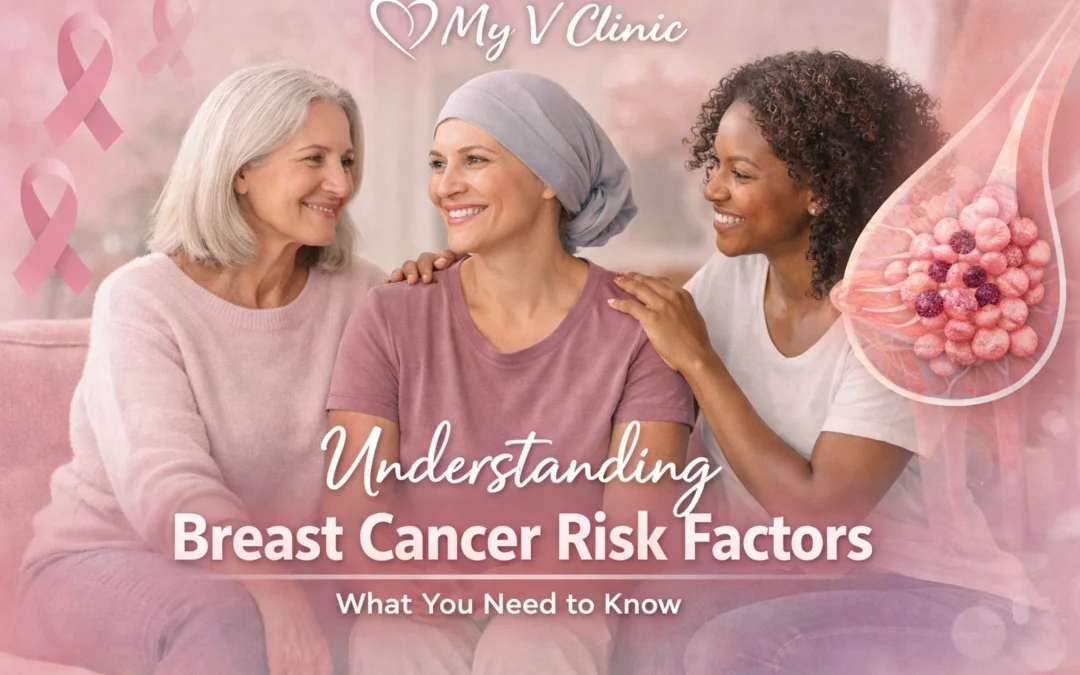
Why Women Are Being Misled About Hormones and Cancer
Hormones and Cancer
Why This Conversation Matters Now
If this is your first time hearing this, hormones are not the villains they have been made out to be. For more than two decades, women have been living under a medical narrative shaped by fear, incomplete data, and outdated interpretations of research. Nowhere is this more obvious than in conversations around hormone replacement therapy (HRT), menopause, breast cancer risk, and female sexual health.
At My V Clinic, we see the downstream effects every day. Women arrive confused, exhausted, anxious, and often ashamed of symptoms they were told are either “normal,” “just aging,” or “too risky to treat.” They are handed fragments of information without context, warned about cancer without real risk explanation, and denied therapies that men routinely receive without question.
This pillar guide exists to correct the record. It synthesizes modern evidence, clinician insights, and patient-centered reasoning to explain what hormones actually do in the body, why women were misled for years, and how informed, individualized care changes outcomes.
This is not about pushing hormones on everyone. This is about accuracy, nuance, and restoring medical honesty.
The Root Problem: Fear-Based Medicine and the Loss of Curiosity
Modern healthcare rewards speed and compliance, not deep thinking. Most clinicians are expected to see 20–30 patients per day, follow rigid guidelines, and minimize deviation. In that environment, curiosity disappears.
Hormone medicine is one of the biggest casualties of this system. Instead of continuous re-evaluation as evidence evolved, early flawed conclusions hardened into dogma.
The result?
- Estrogen labeled as inherently dangerous
- Testosterone framed as inappropriate for women
- Menopause treated as something to endure, not address
This mindset directly contradicts how medicine treats male hormone deficiency. When men lose testosterone, it is investigated, treated, and monitored. When women lose estrogen, progesterone, or testosterone, they are often told it is “just life.”
That discrepancy is not biological. It is cultural.
The Women’s Health Initiative: What Actually Happened
Much of today’s hormone fear traces back to the Women’s Health Initiative (WHI) study in the early 2000s. The headlines were dramatic: hormones cause breast cancer, heart disease, and stroke.
What was lost in translation:
- The average participant was over 63 years old
- Many had existing cardiovascular disease
- Oral synthetic hormones were used
- Timing of initiation was ignored
Personalized hormone support, weight loss, and aesthetic care for people ready to feel like themselves again.
Later re-analyses showed:
- Estrogen-only therapy reduced breast cancer incidence
- Younger women had neutral or beneficial cardiovascular outcomes
- Risk depended on formulation, route, and timing
Yet the fear stuck.
Clinicians stopped prescribing. Medical schools stopped teaching nuance. Women paid the price.
Public reference: https://www.nih.gov/news-events/nih-research-matters/estrogen-alone-menopausal-hormone-therapy
Hormones Do Not “Cause” Cancer
Cancer biology is complex. Hormones do not initiate cancer. They can act as growth signals in existing hormone-sensitive tissues, but that is not the same thing.
Key clarification:
- Cancer begins with genetic mutations and cellular dysregulation
- Hormones influence growth rate, not mutation creation
- Estrogen is essential for immune regulation, DNA repair, and metabolic stability
By the time a cancer is detected, it has often been developing for 10–20 years.
This matters because fear-based rules like “never hormones again” after cancer ignore biology, subtype differences, and patient quality of life.
Authoritative reference: https://www.cancer.gov/about-cancer/causes-prevention/risk/hormones
DCIS, Overtreatment, and the Cost of Fear
Ductal carcinoma in situ (DCIS) is non-invasive. Many cases never progress. Yet treatment often mirrors invasive cancer care.
Consequences include:
- Surgical overtreatment
- Forced menopause
- Sexual dysfunction
- Bone loss
- Cardiovascular decline
In prostate cancer, medicine evolved quickly. Low-grade disease is often monitored. Testosterone is frequently continued.
In breast cancer, fear dominates.
This is not evidence-based equality.
Public reference: https://www.cancer.gov/types/breast/dcis-fact-sheet
The Informed Consent Problem
True informed consent requires understanding risk. Most people do not.
Examples:
- “12% lifetime breast cancer risk” is often misunderstood
- Screening risks are rarely discussed
- Side effects of hormone deprivation are minimized
Risk communication must include:
- Absolute vs relative risk
- Baseline probability
- Competing health risks
Without this, consent is incomplete.
CDC reference: https://www.cdc.gov/cancer/breast/basic_info/risk_factors.htm
Alcohol: The Most Ignored Breast Cancer Risk Factor
Alcohol is one of the strongest modifiable risk factors for breast cancer, yet it is rarely addressed seriously.
Evidence shows:
- Breast cancer is the most common alcohol-related cancer
- Risk increases even at low intake
- Alcohol worsens anxiety, sleep, weight, and hormone balance
Public reference: https://www.cancer.gov/about-cancer/causes-prevention/risk/alcohol
Yet women are routinely denied hormones while being told a nightly drink is harmless.
That contradiction matters.
Sexual Health Is Not Optional Care
Hormone loss affects:
- Libido
- Vaginal tissue integrity
- Urinary health
- Relationship stability
Men undergoing prostate cancer treatment receive explicit counseling on sexual outcomes. Women rarely do.
Vaginal estrogen is widely recognized as safe, even in cancer survivors, yet many women are still denied it.
Professional consensus reference: https://www.acog.org/clinical/clinical-guidance/committee-opinion/articles/2016/12/vaginal-estrogen-use-in-women-with-a-history-of-estrogen-dependent-breast-cancer
Quality of life is not a luxury. It is part of health.
Testosterone in Women: The Most Misunderstood Hormone
Women produce testosterone naturally. It supports:
- Sexual desire
- Muscle mass
- Bone density
- Cognitive function
Research shows appropriate testosterone therapy does not increase breast cancer risk and may be protective in some contexts.
Public reference: https://pubmed.ncbi.nlm.nih.gov/25279562/
Yet misinformation persists because this therapy does not fit outdated narratives.
Why Change Is Slow
Several forces slow reform:
- Institutional inertia
- Profit incentives
- Fear-based messaging
- Litigation anxiety
But patient advocacy is accelerating change.
Educated women ask better questions.
And medicine is being forced to listen.
How My V Clinic Approaches Hormone Care
At My V Clinic, we:
- Individualize every plan
- Use evidence-based dosing
- Prioritize safety and monitoring
- Address lifestyle and metabolic health
- Respect patient autonomy
Hormones are tools, not mandates.
Education is the foundation.
Ongoing Research and Emerging Evidence
Hormone science continues to evolve. Areas under active investigation include:
- Estrogen’s role in immune surveillance
- Testosterone and breast cancer risk modulation
- Timing hypothesis and cardiovascular protection
- Non-invasive biomarker screening
We continuously update care protocols as evidence develops.
FAQs
Do hormones cause breast cancer?
Hormones do not initiate cancer. Breast cancer begins with genetic and cellular changes that develop over many years. Estrogen and other hormones can influence the growth of existing hormone-sensitive tissue, but they are not considered a root cause of cancer formation. This distinction is often lost in public messaging and leads to unnecessary fear.
Is estrogen always dangerous after menopause?
No. Estrogen is not inherently dangerous after menopause. Risk depends on factors such as age, timing of therapy initiation, dose, formulation, route of delivery, and individual health history. Large studies have shown that estrogen can be neutral or beneficial for many women when used appropriately and monitored carefully.
Can cancer survivors ever use hormones?
In some cases, yes. Hormone decisions after cancer depend on cancer type, receptor status, treatment history, and current health. Blanket rules that prohibit all hormone use do not reflect modern evidence. Decisions should be individualized and made collaboratively with informed medical guidance.
Is vaginal estrogen safe?
Vaginal estrogen is widely considered safe for most women, including many breast cancer survivors. It is minimally absorbed into the bloodstream and is used to treat local symptoms such as vaginal dryness, pain with intimacy, and urinary issues. Multiple professional medical organizations recognize its safety when appropriately prescribed.
Does alcohol matter more than hormones?
Alcohol is a well-established, modifiable risk factor for breast cancer and is often underemphasized in clinical conversations. Even low levels of alcohol intake can increase risk. Alcohol also negatively affects sleep, mood, metabolic health, and hormone balance, which can compound overall health concerns.
Why were women told hormones were unsafe?
Much of the fear originated from early interpretations of large studies that were later shown to be incomplete or misapplied. Over time, simplified messaging replaced nuanced science, and the narrative persisted even as evidence evolved. Medical training and public health messaging were slow to update, reinforcing outdated beliefs.
Is testosterone appropriate for women?
Women naturally produce testosterone, and it plays an important role in bone density, muscle mass, cognitive function, and sexual health. In appropriate doses and with proper monitoring, testosterone therapy may be considered for some women. It is not a male hormone, and its use should be evaluated based on individual needs.
How is risk actually calculated?
Risk is calculated using population data, personal health history, genetics, lifestyle factors, and age. Many commonly cited “lifetime risk” numbers are misunderstood and do not mean that a woman has that risk every year of her life. Understanding absolute versus relative risk is essential for informed decision-making.
What monitoring is required?
Responsible hormone care includes regular clinical follow-up, symptom assessment, laboratory testing when appropriate, and ongoing reassessment of risks and benefits. Monitoring ensures therapy remains aligned with a patient’s health status and goals rather than being static or automatic.
How do I know if hormones are right for me?
Hormone therapy is a personal medical decision based on symptoms, health history, risk tolerance, and quality-of-life considerations. Education, informed consent, and individualized evaluation are essential. Hormones are tools, not requirements, and the right approach is one that aligns with both evidence and the patient’s priorities.