

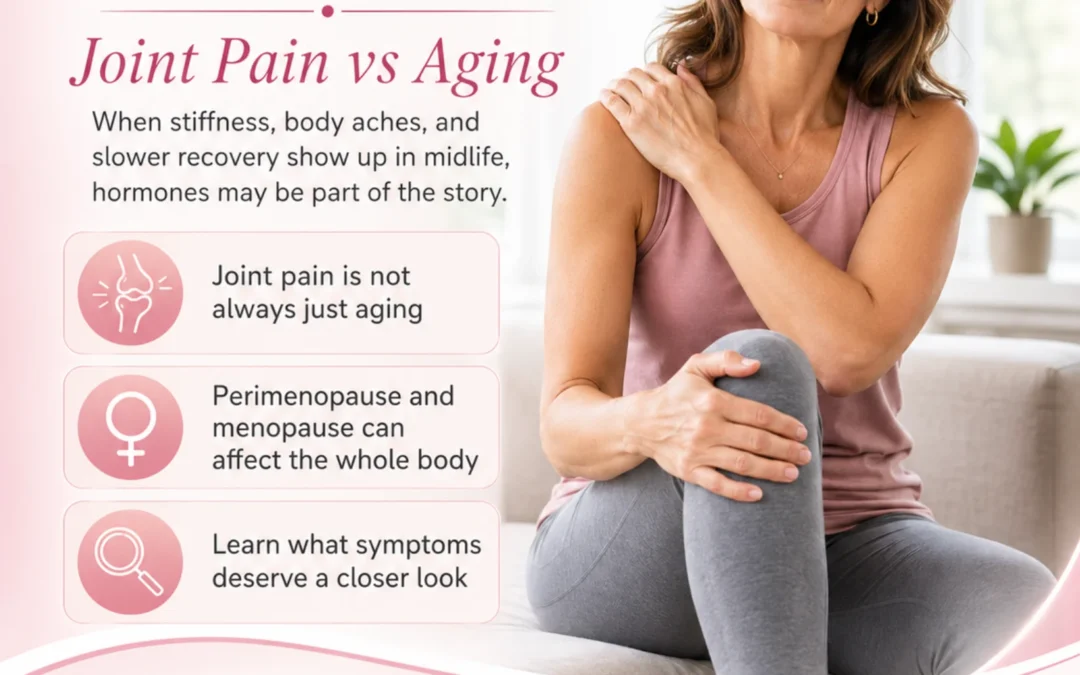
Am I Broken, or Is It Menopause? The Joint Pain Question Too Many Women Ask
Am I Broken, or Is It Menopause?
Menopause joint pain can make a woman wonder, “Am I broken, or am I just getting old?” Menopause joint pain is one of those symptoms that sneaks up quietly, then starts affecting everything from getting out of bed to climbing stairs, working out, sleeping, and feeling like yourself. If this is your first time hearing this, joint pain in midlife is not always just age, weight, bad luck, or “wear and tear.”
A recent educational reel by Dr. Mary Claire Haver brought attention to a point many women have felt in their own bodies: joint pain is often dismissed as aging when it may be connected to perimenopause or menopause. Dr. Haver is a board certified OB GYN and Menopause Society Certified Practitioner who has become widely known for public education around menopause and midlife health. Her broader message lines up with newer medical discussion around what some researchers now call the musculoskeletal syndrome of menopause.
That does not mean every aching knee, stiff shoulder, sore hip, or tight hand is caused by hormones. That would be too easy, and the body rarely works that neatly. Joint pain can also come from arthritis, injury, inflammation, thyroid disease, autoimmune conditions, low vitamin D, poor sleep, excess stress, muscle loss, or changes in activity. But when joint pain starts or worsens during the same season as hot flashes, sleep changes, mood shifts, cycle changes, weight changes, vaginal dryness, or low energy, hormones deserve a seat at the table. Cleveland Clinic notes that estrogen declines through perimenopause and menopause, and lower estrogen is associated with a wide range of symptoms and health changes.
For women in Thornton, Denver, Westminster, Northglenn, Broomfield, and the surrounding Colorado area, this matters because active midlife women often blame themselves first. They say, “I need to stretch more.” “I need to lose weight.” “I must be getting lazy.” “Maybe this is just what 45 or 52 feels like.” Sometimes those things are part of the picture. But sometimes the deeper issue is that the body is changing faster than the woman was ever warned about.
At <a href=”https://myvclinic.com/services/hormone-replacement-therapy/” style=”color:#ec45a90;”>My V Clinic hormone replacement therapy</a>, the conversation starts with listening, symptoms, history, lab guided evaluation, and practical next steps. The goal is not to chase youth or pretend aging does not happen. The goal is to stop dismissing women when their bodies are clearly trying to get their attention.
The Problem: Women Are Told Joint Pain Is Just Age
One of the most frustrating things about midlife joint pain is how quickly it gets brushed off.
A woman says, “My hands hurt in the morning.”
She hears, “That happens when you get older.”
She says, “My knees ache, but I did not injure them.”
She hears, “Lose a little weight.”
She says, “My shoulder is frozen, my hips are stiff, and I feel like I aged ten years overnight.”
She hears, “Welcome to your 40s.”
That kind of answer may sound harmless, but it can leave women feeling ignored. It also delays a better conversation. Aging is real. Nobody gets a free pass from time. But “getting older” is not a diagnosis. It is a calendar fact.
The menopause transition is more than hot flashes. The Office on Women’s Health explains that menopause does not happen all at once. Perimenopause can last for years, and symptoms can begin before periods stop completely.
Personalized hormone support, weight loss, and aesthetic care for people ready to feel like themselves again.
That is where many women get caught. They are still having periods, so nobody brings up menopause. They are not “old,” so they blame themselves. They are tired, sore, irritable, foggy, and sleeping poorly, but their symptoms are treated like separate little problems instead of one bigger pattern.
Joint pain during this stage can feel like:
• Morning stiffness that takes longer to loosen up
• Achy knees, hips, hands, feet, shoulders, or back
• Soreness after workouts that used to feel easy
• Tight tendons or pulled muscle feeling without a clear injury
• New trouble with stairs, squats, gripping, lifting, or reaching overhead
• Frozen shoulder or reduced shoulder range of motion
• General body aches that move around
• Feeling like recovery has gone downhill
The hard part is that none of these symptoms automatically scream “menopause.” They can look like orthopedic issues. They can look like overuse. They can look like arthritis. They can look like stress. That is why many women spend months, sometimes years, chasing symptoms without ever being asked about their hormonal transition.
Your Joints Are Part of a Bigger System
Your joints are not floating around by themselves. They are part of a full system. When one part of that system changes, the rest of the body can feel it too.
That system includes:
When hormones shift, several parts of that system can shift too.
That is why a woman may say, “I did not change anything, but my body feels different.” She may not be imagining it. The body may actually be operating under different hormonal conditions than it was five years ago.
The Deeper Problem: Estrogen Affects More Than Periods
Estrogen is not just a period hormone. That is the old, incomplete story.
Estrogen receptors are found throughout the body, including tissues involved in bones, joints, muscles, tendons, ligaments, and pain signaling. Research reviews have described links between sex hormone changes and musculoskeletal pain, including pain connected to osteoarthritis and menopause transition symptoms.
That matters because women are often taught to associate menopause only with hot flashes and periods stopping. Then when joint pain shows up, they separate it from menopause entirely.
If estrogen helps influence inflammation, connective tissue function, muscle strength, pain sensitivity, sleep, and bone health, then a major estrogen drop can affect how a woman feels in her body. That does not make estrogen a magic answer. It simply means hormone changes can change the playing field.
A 2024 medical review introduced the term “musculoskeletal syndrome of menopause” to describe a group of symptoms influenced by estrogen changes, including joint pain, reduced muscle mass, bone changes, and related musculoskeletal concerns.
The Solution Framework: Stop Asking “Am I Broken?” and Start Asking Better Questions
The better question is not, “Am I broken?”
The better question is, “What changed, and what needs to be evaluated?”
That one shift matters.
When a woman thinks she is broken, she usually blames herself. She pushes harder. She ignores pain. She assumes she is weak. She buys another supplement. She starts a workout plan that may not match where her body is. Or she quits moving altogether because everything hurts.
When she asks what changed, she gets more practical.
A better evaluation should look at the full picture:
• When did the pain start?
• Did it begin around cycle changes, hot flashes, sleep changes, mood changes, or weight changes?
• Is pain worse in the morning?
• Are joints swollen, red, hot, or visibly inflamed?
• Is the pain on both sides or one specific area?
• Did an injury happen?
• Has exercise tolerance changed?
• Are there signs of thyroid disease, autoimmune disease, or inflammatory arthritis?
• Has vitamin D, iron, B12, thyroid, glucose, inflammatory markers, or hormone status been reviewed when appropriate?
• Is sleep poor enough to amplify pain?
• Has muscle mass declined?
At <a href=”https://myvclinic.com/” style=”color:#ec45a90;”>My V Clinic in Thornton, CO</a>, this is where lab guided care matters. Symptoms tell part of the story. Labs tell another part. History fills in the gaps. No single lab number explains the whole woman, but ignoring labs is not smart either.
A good plan may include lifestyle changes, strength training, nutrition support, sleep improvement, medical evaluation, hormone discussion, and referrals when needed. Sometimes hormone therapy may be considered. Sometimes it is not the right fit. The point is not to force one answer. The point is to stop pretending women are making it up.
Menopause Joint Pain vs Old Age: How to Tell the Difference
This is where the title gets real.
Old age usually sounds gradual.
Menopause related joint pain often feels more sudden or confusing.
That does not mean it happens overnight for everyone. But many women describe a noticeable shift. One year they are moving through life normally. Then suddenly they feel stiff, sore, inflamed, fragile, tired, and older than they expected.
Here is a practical way to think about it.
Pain may be more connected to menopause when:
• It begins in the 40s or 50s during cycle changes or after periods stop
• It appears with hot flashes, night sweats, sleep disruption, mood changes, or brain fog
• It affects multiple areas instead of one injured joint
• Stiffness is worse in the morning or after sitting
• Recovery after exercise suddenly worsens
• Shoulder stiffness or frozen shoulder appears without a clear injury
• Joint pain comes with vaginal dryness, urinary changes, low libido, or energy changes
Pain may need urgent or separate medical evaluation when:
• One joint is red, hot, swollen, or severely painful
• Pain follows a fall or injury
• There is fever, unexplained weight loss, rash, or severe fatigue
• There is numbness, weakness, or nerve symptoms
• Pain wakes you from sleep consistently
• You cannot bear weight
• Symptoms suggest autoimmune disease or inflammatory arthritis
This is where common sense still matters. Menopause may be part of the story, but it should not become a garbage can diagnosis where every symptom gets tossed in without proper evaluation.
The smarter approach is both.
Consider hormones.
Rule out other causes.
Build a plan.
That is grown up medicine. Not glamorous, but it beats guessing.
Why Frozen Shoulder Gets Mentioned So Often in Midlife Women
Frozen shoulder, also called adhesive capsulitis, is one of the conditions that gets brought up often in conversations about midlife women and hormonal change. It causes pain, stiffness, and reduced shoulder movement. It can make simple things hard, like reaching into a cabinet, hooking a bra, washing hair, or sleeping on one side.
The musculoskeletal syndrome of menopause review includes frozen shoulder among menopause associated musculoskeletal issues being discussed in this newer framework.
That does not mean every frozen shoulder is caused by menopause. Frozen shoulder can also be linked with diabetes, thyroid issues, injury, surgery, and other risk factors. But when a woman in perimenopause or menopause develops shoulder stiffness without an obvious injury, hormone changes should not be ignored.
This is exactly the kind of symptom that can make a woman feel like she is falling apart.
She is not broken.
But she may need better evaluation.
The Proper Execution: What Women Should Actually Do
Here is the part that matters most.
Do not just hear “menopause joint pain” and jump straight to hormones.
That is not careful care. That is internet medicine, and internet medicine can get people into trouble faster than a cheap folding chair.
A better process looks like this:
First, document the pattern.
Write down where the pain is, when it started, what makes it better or worse, and what else changed around the same time. Include sleep, cycle changes, mood, hot flashes, night sweats, weight changes, libido, vaginal dryness, urinary symptoms, and exercise tolerance.
Second, check for red flags.
Severe swelling, redness, warmth, fever, trauma, inability to walk, numbness, weakness, or sudden severe pain should be evaluated promptly.
Third, look at the whole health picture.
Joint pain may overlap with thyroid changes, vitamin D deficiency, autoimmune disease, inflammatory arthritis, osteoarthritis, metabolic health, poor sleep, stress, and muscle loss. Menopause can be involved, but it should not be assumed without looking at the rest of the body.
Fourth, rebuild strength intelligently.
Midlife women need strength training, but the plan has to match the person. If a woman has lost muscle, slept poorly for months, and has joint pain, jumping into aggressive workouts may backfire. Start with smart resistance training, mobility, walking, protein intake, recovery, and consistency.
Fifth, talk about hormone options when appropriate.
Menopausal hormone therapy may be appropriate for some women and not appropriate for others. The decision depends on symptoms, medical history, risk factors, timing, goals, and clinician guidance. Cleveland Clinic notes that menopause symptoms may be treated with options including hormone therapy, medications, and lifestyle adjustments.
Sixth, follow up.
One visit rarely solves years of symptoms. A good plan should be monitored. If symptoms improve, keep building. If they do not, reassess. The body gives feedback, and good care listens to it.
At <a href=”https://myvclinic.com/services/telemedicine-follow-ups/” style=”color:#ec45a90;”>My V Clinic telemedicine follow ups</a>, ongoing care may be available after an initial in clinic evaluation when medically appropriate. That matters because hormone and midlife care is not a one and done conversation.
Why “You Are Just Getting Older” Is Not Good Enough
There is a difference between aging and being dismissed.
Aging is real.
Dismissal is optional.
Women deserve better than being handed a shrug and told to accept pain as their new personality.
The World Health Organization describes menopause as part of a continuum of life stages, most often occurring between ages 45 and 55. That means menopause is normal. But normal does not mean symptom free. Normal does not mean easy. Normal does not mean women should live with preventable suffering.
A woman can accept aging and still ask for help.
A woman can be realistic and still want answers.
A woman can be strong and still say, “Something changed.”
This is where My V Clinic’s role as a guide matters. The patient is not the problem. The problem is the gap between what women are experiencing and what they were taught to expect.
Most women were not taught that perimenopause can affect sleep, mood, energy, periods, sexual health, weight, metabolism, brain fog, and musculoskeletal comfort. They were taught to expect hot flashes and maybe mood swings. That is like handing someone a map of Colorado with only Denver labeled. Good luck finding Thornton, Boulder, or I 70 in a snowstorm.
Guide Positioning: What My V Clinic Wants Women to Know
My V Clinic is not here to tell every woman that hormones are the answer to every problem.
That would be lazy.
My V Clinic is here to help women ask better questions and get more complete care.
For a woman dealing with joint pain in perimenopause or menopause, the goal is to understand:
• What symptoms are present?
• What stage of hormonal transition may be happening?
• What labs make sense?
• What health risks need to be reviewed?
• What lifestyle foundations need support?
• What treatments are reasonable?
• What needs referral to primary care, orthopedics, rheumatology, physical therapy, or another specialist?
That is a better model than “you are fine” or “here is a bottle of pills.”
Women deserve care that sees the pattern.
They deserve care that explains the why.
They deserve care that respects both science and lived experience.
Expert Authority Integration: Why Dr. Mary Claire Haver’s Message Matters
The reel that sparked this blog is powerful because it names something women have been feeling for years.
Dr. Mary Claire Haver’s point is not that every woman with joint pain needs hormone therapy. The stronger message is that joint pain in midlife should not be automatically written off as old age.
Dr. Haver is publicly listed as a board certified Obstetrics and Gynecology specialist and Menopause Society Certified Practitioner, and her educational platforms focus on menopause, perimenopause, and midlife women’s health.
Her message connects with newer discussion in the medical literature around musculoskeletal syndrome of menopause. That term is still relatively new in public conversation, but it gives language to something women have described for decades: stiffness, pain, weakness, and body changes that seem to cluster around hormonal transition.
Language matters.
When a symptom has no name, women are easier to dismiss.
When a pattern has a name, women can advocate more clearly.
This content is for educational purposes only and does not constitute medical advice. It does not diagnose, treat, cure, or prevent any condition. Always consult a qualified healthcare professional regarding symptoms, medications, or treatment decisions.
Common Questions About Menopause Joint Pain
Midlife joint pain can feel confusing because it may look like aging, arthritis, stress, overuse, or hormone changes. These answers help explain what may be happening and when it is time to take a closer look.
1Is joint pain really a menopause symptom?
Yes, joint pain can happen during perimenopause and menopause. It may be connected to changing estrogen levels, inflammation, sleep disruption, muscle changes, and pain sensitivity. But joint pain can also come from arthritis, injury, thyroid disease, autoimmune disease, or other conditions, so evaluation matters.
2What is musculoskeletal syndrome of menopause?
Musculoskeletal syndrome of menopause is a newer term used to describe a group of menopause associated symptoms affecting joints, muscles, tendons, ligaments, bone, strength, and mobility. It is linked to the effects of estrogen changes on the musculoskeletal system.
3How do I know if my joint pain is menopause or arthritis?
You may not know without evaluation. Menopause related pain may show up with other symptoms like hot flashes, sleep disruption, cycle changes, mood changes, vaginal dryness, and widespread stiffness. Arthritis may involve specific joint degeneration, swelling, limited motion, or imaging changes. Sometimes both are present.
4Can perimenopause cause body aches before periods stop?
Yes. Perimenopause can begin years before menopause, while periods are still happening. Symptoms may start during this transition because hormones can fluctuate before they fully decline.
5Does hormone therapy help joint pain?
Hormone therapy may help some menopausal symptoms for some women, and research is exploring musculoskeletal effects. It is not a guaranteed joint pain cure. Whether it is appropriate depends on symptoms, medical history, timing, risks, and clinician guidance.
6What joints hurt most during menopause?
Women often report aches in the hands, knees, hips, feet, shoulders, neck, and back. Some women also describe tendon pain, muscle tightness, or frozen shoulder symptoms.
7Should I see a hormone clinic or an orthopedic doctor?
It depends on the pain pattern. If there is injury, swelling, severe localized pain, or loss of function, orthopedic or primary care evaluation may be needed. If joint pain appears along with perimenopause or menopause symptoms, a hormone focused evaluation may also be helpful.
8Can poor sleep make menopause joint pain worse?
Yes. Poor sleep can worsen pain sensitivity, recovery, inflammation, mood, and energy. Since sleep disruption is common during perimenopause and menopause, it can make joint pain feel worse.
9Can strength training help menopause joint pain?
For many women, properly guided strength training can support muscles, joints, balance, bone health, and metabolism. The key is proper progression. Going too hard too soon can aggravate symptoms.
10When should joint pain be checked right away?
Get medical care promptly if a joint is red, hot, swollen, severely painful, follows an injury, causes inability to bear weight, comes with fever, or includes numbness, weakness, or unexplained weight loss.
Bottom line: joint pain in midlife should not be brushed off as just getting older. Sometimes it is aging. Sometimes it is arthritis. Sometimes hormones are part of the story. The smart move is to look at the full picture.
Related Reading
- Menopause Care and Symptom Support
- Hormone Therapy Options and Safety Basics
- Sexual Wellness After 40
- GSM: Vaginal and Urinary Symptoms Explained
This content is for educational purposes only and does not constitute medical advice. It does not diagnose, treat, cure, or prevent any condition. Always consult a qualified healthcare professional regarding symptoms, medications, or treatment decisions.