

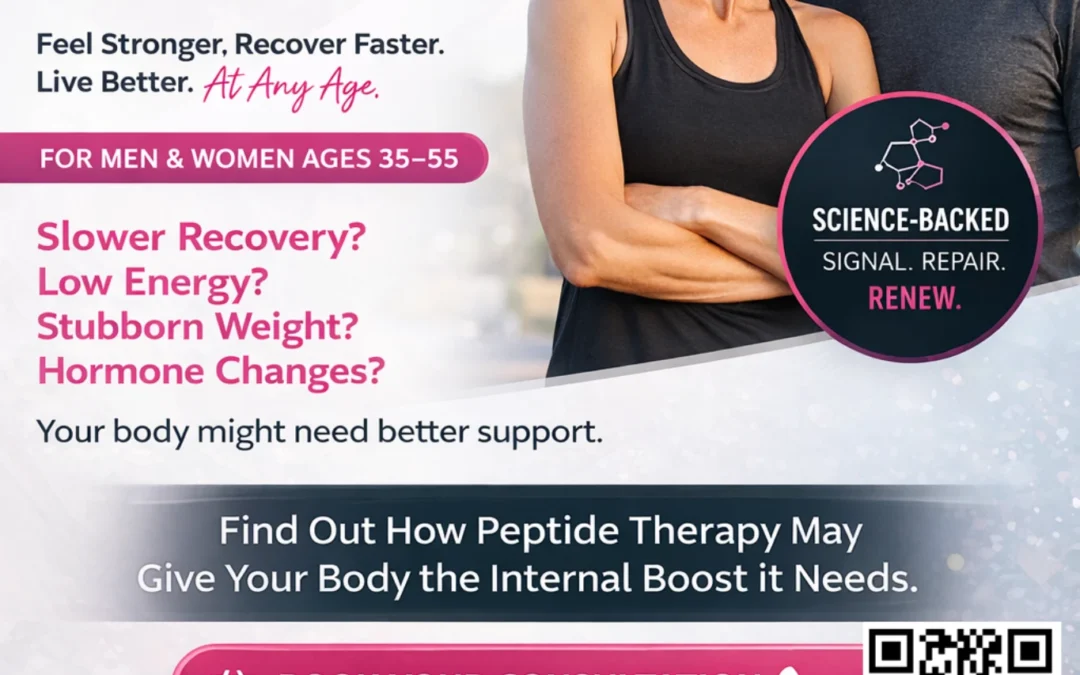
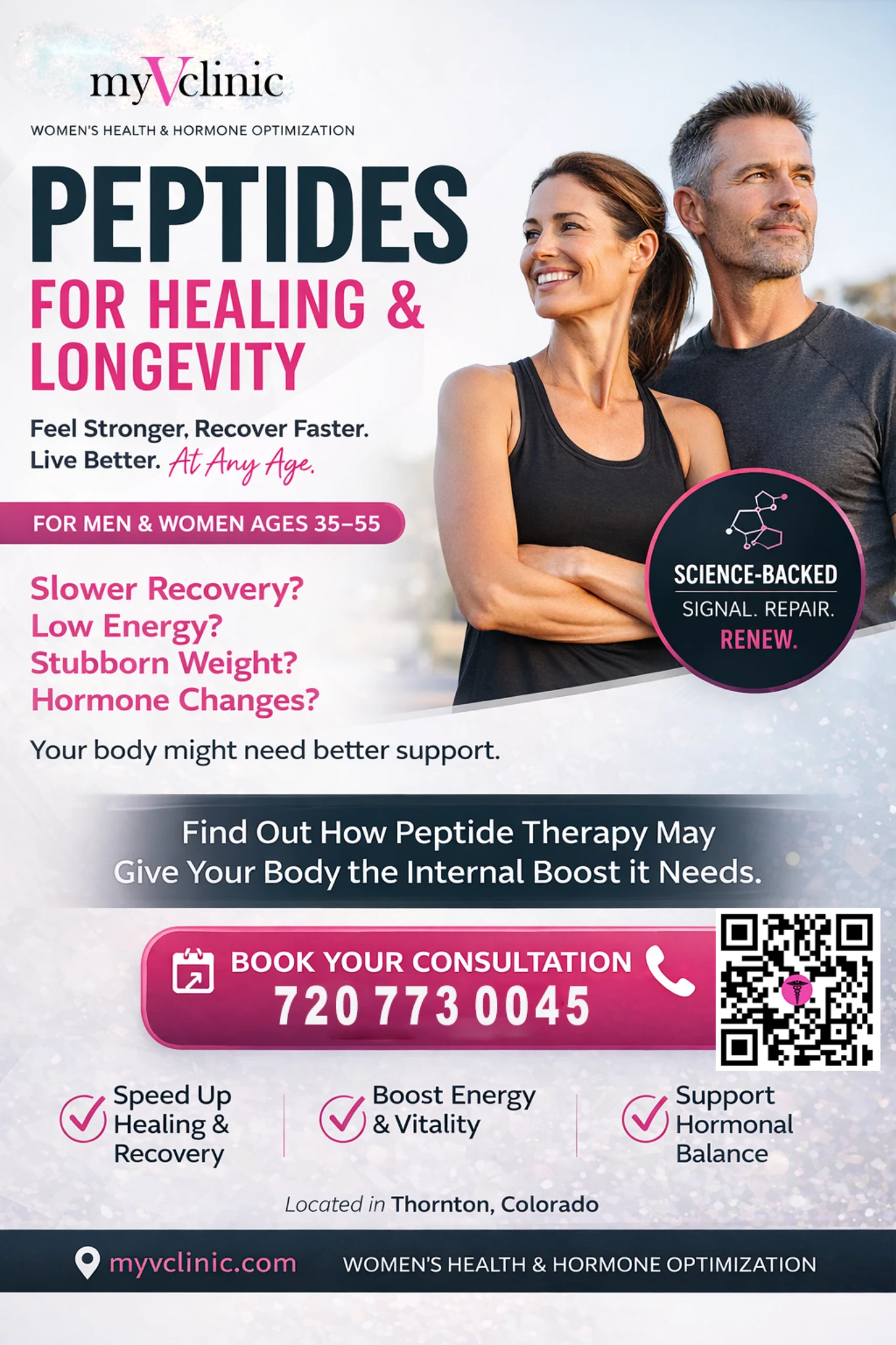
Peptides for Healing and Longevity
Are Peptides for Healing
Peptides for healing and longevity usually come up when something in your body stops responding the way it should. Peptides for healing and longevity are being explored because peptides for healing and longevity may help your body restart the internal communication needed for repair, recovery, and consistent performance.
Most people do not start here.
They start by pushing through.
You give it time. You rest. You try to outwork the problem. At first, that usually works. Then one day, it does not. The shoulder still aches. The knee still feels off. You wake up tired even after a full night of sleep. Workouts take more out of you than they give back.
That is when the question changes.
It is no longer, “How do I push harder?”
It becomes, “Why is my body not responding?”
That is the real reason people start looking into peptides.
At My V Clinic, we look at that question first. Not the treatment. Not the trend. The actual breakdown that led you here.
Because until that is clear, nothing else matters.
What Is Actually Breaking Down Inside the Body
Peptides for healing and longevity are not about adding something new. They are about restoring something that is already supposed to be there.
Your body operates through constant communication. Every system depends on signals telling it what to do and when to do it.
Those signals control:
• When to repair damaged tissue
• When to reduce inflammation
• When to release hormones
• When to rest and recover
• When to produce energy
As time goes on, those signals lose strength.
They do not shut off completely. They just become less effective.
That is why healing slows down.
That is why inflammation lingers.
That is why energy feels inconsistent.
It is not always the injury or the condition itself. It is the delayed or incomplete response from your body.
What Peptides Really Are Without the Hype
Peptides are short chains of amino acids. That is the definition you will hear everywhere.
Here is what matters more.
They act like instructions.
Your body uses peptides to deliver messages between cells. When those messages are clear and timely, systems work smoothly. When they are weak or delayed, systems fall out of sync.
You still have the ability to heal.
The signal just is not strong enough to get the job done efficiently.
That is where peptide therapy may come into play.
What Changes When the Signal Improves
When someone asks what peptides will actually do for them, the answer should be direct.
They help your body respond better.
That response can show up in different ways depending on the person, but commonly includes:
• More consistent recovery after activity
• Reduced lingering soreness or stiffness
• Improved response to injury
• Better sleep patterns
• More stable energy throughout the day
Nothing here is forced.
The body is not being overridden.
It is being supported so it can function closer to how it was designed to.
Personalized hormone support, weight loss, and aesthetic care for people ready to feel like themselves again.
Why Recovery Becomes the First Red Flag
Most people notice the problem during recovery before anything else.
You tweak something and expect it to improve. Instead, it stays the same or gets worse. You rest longer than usual and still feel off. You return to activity and the issue comes right back.
That pattern is not random.
It is usually tied to a breakdown in signaling.
Peptides for healing and longevity are often considered at this stage because they may help reinforce the communication needed to complete the repair process.
Without that signal, the body stays stuck in a loop.
Longevity Is About Function, Not Just Time
The word longevity gets thrown around a lot, but most people are not chasing extra years.
They want to feel capable in the years they already have.
Peptides for healing and longevity are being explored because they may support the systems that keep you functioning well over time.
That includes:
• Sleep quality
• Hormone balance
• Immune response
• Energy production
• Cellular repair
When those systems are stable, everything else becomes easier to manage.
When they are not, small issues start stacking up.
The Real Question: Why Would You Need This
If you are asking about peptides, it usually comes down to one thing.
Something is not improving the way it should.
That might look like:
• Injuries that do not fully resolve
• Constant fatigue that does not match your lifestyle
• Trouble maintaining strength or endurance
• Sleep that never feels complete
• A general sense that your body is not keeping up
You are not looking for an upgrade.
You are trying to get back to baseline.
Peptides may help support that return when the underlying issue is tied to weakened internal communication.
How My V Clinic Handles This Step by Step
At My V Clinic, peptides are not treated like a starting point.
They are part of a structured plan built around you.
The process always begins with understanding the full picture:
• Daily habits
• Sleep consistency
• Stress levels
• Hormonal patterns
• Nutritional intake
From there, the focus is on rebuilding the foundation.
That means correcting what is already within your control before introducing anything new.
Only after that foundation is solid do we consider adding peptides.
This is where most people see the difference.
Because now the body is ready to respond.
What You Should Expect Moving Forward
Peptides for healing and longevity are not instant solutions.
They are support tools.
Used correctly, they can help improve how your body responds over time.
That may include:
• Faster recovery cycles
• More consistent energy
• Better overall stability
The goal is not to chase extremes.
The goal is to restore function.
When your body is working the way it should, everything else starts to fall into place.
Clinical Perspective and Ongoing Education
Peptide therapy continues to be explored within integrative medicine, with physicians such as Dr. Edwin Lee contributing to the understanding of how these signaling molecules influence recovery and overall function.
Educational discussions like Why Peptides Are The Secret to Better Health and Longevity highlight how peptides are being used in real clinical settings to support healing, energy, and long term performance.
The consistent takeaway is simple.
Peptides are not the foundation.
They are a tool used once the foundation is in place.
FAQs
• Why would I need peptides?
Because your body may not be signaling effectively for repair or recovery, and peptides may help support that process.
• How do you determine if they are right for me?
We evaluate your overall health first and only introduce peptides if they align with your needs.
• Are peptides a replacement for healthy habits?
No. They support your system but do not replace lifestyle improvements.
• How long before I notice changes?
That depends on your condition and how your body responds over time.
• Do all peptides require injections?
Some do, while others may be available in different forms depending on the protocol.
• Are they safe to use?
When sourced properly and used under guidance, they are generally well tolerated.
• Can peptides help with energy?
They may support the systems responsible for producing and maintaining energy.
• Do they improve sleep?
Certain peptides may support better sleep regulation.
• Are peptides permanent solutions?
No. They are used as part of a larger plan to support function.
• What makes your clinic different?
We focus on restoring your foundation first, then layering in advanced support only when needed.
Sources
- Peptide Therapeutics Overview – NIH
- Peptides in Regenerative Medicine – Frontiers
- Why Peptides Are The Secret to Better Health and Longevity
This content is for educational purposes only and does not constitute medical advice. It does not diagnose, treat, cure, or prevent any condition. Always consult a qualified healthcare professional regarding symptoms, medications, or treatment decisions.
Related Reading
- Menopause Care and Symptom Support
- Hormone Therapy Options and Safety Basics
- Sexual Wellness After 40
- GSM: Vaginal and Urinary Symptoms Explained
This content is for educational purposes only and does not constitute medical advice. It does not diagnose, treat, cure, or prevent any condition. Always consult a qualified healthcare professional regarding symptoms, medications, or treatment decisions.