

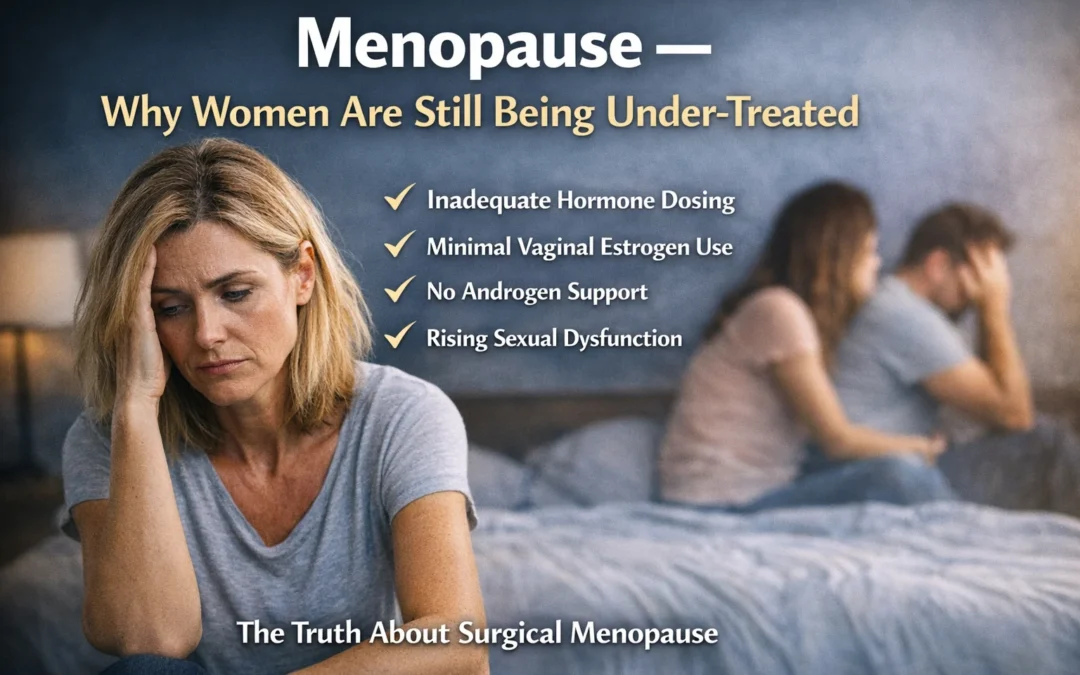
Menopause — Why Women Are Still Being Under-Treated
Menopause
If this is your first time hearing this, here’s the blunt truth: a lot of “menopause care” (especially after ovary removal) is still being delivered like it’s 1998 — symptom-whack-a-mole, minimal dosing, little follow-up, and almost no real conversation about sex, pain, or relationships.
A newly published 2026 paper followed pre-menopausal women after risk-reducing removal of the ovaries and compared them to age-matched controls who kept their ovaries. The outcomes weren’t subtle, and the “hormones didn’t help” take is easy to misread if you don’t look at what patients actually received.
This post breaks down what that study found, what it likely means in real life, and what adequate, adult-level care should look like.
What the 2026 Study Looked At
The research followed pre-menopausal women for 24 months after risk-reducing salpingo-oophorectomy (RRSO) and measured sexual function and sexual distress over time.
Key context that matters:
-
A meaningful portion of participants were under 40 (this is abrupt endocrine loss, not gradual natural menopause).
-
The study tracked multiple dimensions of sexual function, not just “libido.”
If you want to look it up later for your citations, start with the PubMed record and then pull the full-text journal page:
What Happened by 24 Months
By two years after surgery, sexual function and comfort worsened in the RRSO group. The paper reports increased sexual dysfunction and distress after surgery.
The real-world translation is simple:
-
Less desire and arousal
-
More dryness and discomfort
-
More pain with sex
-
More distress about it (which spills into self-image and relationships)
That doesn’t mean every woman will experience every symptom — but it does confirm what many women report: surgical menopause can hit hard and keep hitting when the support plan is light.
The “Hormones Didn’t Help” Line — Why It’s Easy to Misinterpret
The study concluded that use of hormone therapy (HRT) was not associated with better sexual function.
Here’s the problem: “HRT” is a wide umbrella. It can mean:
Personalized hormone support, weight loss, and aesthetic care for people ready to feel like themselves again.
-
Symptom-level dosing (bare minimum to reduce hot flashes)
-
Physiologic replacement dosing (closer to what ovaries produced before surgery)
-
Systemic estrogen without local vaginal therapy
-
No attention at all to pelvic floor dysfunction
-
No attention to androgen loss (testosterone)
When care is incomplete, it’s not surprising that outcomes don’t improve much. That’s not “hormones don’t work.” That’s “the plan wasn’t built for the physiology.”
Why Dosing Matters More in Younger Surgical Menopause
A 35-year-old who loses ovarian function overnight is not the same clinical situation as a 54-year-old transitioning naturally.
This is where many practices accidentally under-treat:
-
They prescribe estrogen like it’s routine menopause symptom management
-
When what’s often needed is closer to true replacement (individualized, monitored, and adjusted)
Authoritative guidance for estrogen replacement-level therapy exists in adjacent clinical situations like primary ovarian insufficiency (POI), which is also early loss of ovarian function. ACOG describes replacement approaches such as 100 mcg transdermal estradiol or 1–2 mg oral estradiol as examples of achieving replacement levels. ACOG: Hormone Therapy in Primary Ovarian Insufficiency
That doesn’t mean everyone should be on the same dose. It means “starter doses” that might be fine for mild hot flashes may be inadequate for abrupt endocrine loss.
The Missed Workhorse: Local Vaginal Estrogen for Pain and GSM
Genitourinary Syndrome of Menopause (GSM) is the umbrella term for vaginal and urinary symptoms caused by estrogen loss: dryness, burning, recurrent irritation, pain with sex, urinary urgency, and more.
The Menopause Society (formerly NAMS) states hormone therapy is the most effective treatment for vasomotor symptoms and GSM. NAMS 2022 Hormone Therapy Position Statement (PubMed).
In the 2026 RRSO paper, vaginal estrogen use was very low even though pain and discomfort worsened (per the summary you shared and the overall findings about function and distress).
Plain English:
-
Systemic estrogen can help, but it’s not always enough for vaginal tissue.
-
Local vaginal estrogen is often the missing piece for pain and dryness.
-
If sex is painful, “try lube” is not a plan. It’s a shrug.
Androgens: The Conversation That Keeps Not Happening
Ovaries contribute to androgen production, and after removal, some women experience significant drops that can affect sexual desire and responsiveness.
There’s a reason international sexual-medicine groups put real guidance in writing: the International Society for the Study of Women’s Sexual Health (ISSWSH) published a clinical practice guideline on systemic testosterone for women with hypoactive sexual desire disorder (HSDD), including patient selection, dosing principles, and monitoring. ISSWSH Testosterone Guideline (summary page).
This is not a DIY lane. It’s a “carefully prescribed and monitored” lane — but ignoring it entirely leaves a chunk of physiology unaddressed.
Pelvic Floor Support: The Unsexy Fix That Actually Helps
When pain shows up, it’s not always just tissue dryness. Guarding, muscle tightness, and pelvic floor dysfunction can layer on quickly, especially after a big hormonal shift plus anxiety around pain.
A serious plan may include:
-
Pelvic floor physical therapy
-
Gradual reintroduction strategies (not “push through it”)
-
Addressing partner communication (because avoidance spirals are real)
This is the relationship-saving work nobody advertises, but it matters.
The Ethical Problem Nobody Wants to Say Out Loud
Risk-reducing ovary removal can be medically appropriate and even life-saving in high-risk patients. But ethically, you can’t do the “big intervention” and then provide “small support.”
If a patient is pre-menopausal (especially under 40), abrupt endocrine loss is foreseeable. Sexual changes are foreseeable. Bone and cardiometabolic issues are foreseeable.
So a bare-minimum, under-dosed, “see you next year” approach is not neutral.
It’s choosing to accept predictable harm.
What Adequate Care After Surgical Menopause Can Look Like
This is a practical, patient-centered checklist you can use to structure a better standard of care (and a better blog):
Systemic hormone strategy
-
Clear goals (symptom relief vs physiologic replacement)
-
Appropriate route (transdermal vs oral) based on risk factors and preferences
-
Dose titration with follow-up, not a one-and-done
GSM and pain strategy
-
Early assessment for dryness, burning, and pain
-
Consider local vaginal estrogen when indicated (not as a “last resort”)
-
Lubricants/moisturizers as support tools, not the whole plan
Sexual function strategy
-
Ask about desire, arousal, and distress directly (most patients won’t volunteer it)
-
Consider androgen evaluation and specialist-guided options when appropriate, using established guidance such as ISSWSH’s framework
-
Address relationship dynamics and communication (because hormones don’t fix resentment)
Pelvic floor strategy
-
Screen for pelvic floor dysfunction early
-
Refer to pelvic PT when pain, tightness, or avoidance patterns appear
Ongoing Research and Emerging Evidence
This area is evolving fast, and the headlines often oversimplify. Two things can be true at the same time:
-
Studies can show worsening sexual outcomes after RRSO.
-
“HRT wasn’t associated with improvement” can reflect treatment variability, under-dosing, limited local therapy, lack of androgen consideration, and inconsistent follow-up — not the inherent failure of hormones.
What we need more of:
-
Trials that define “adequate replacement” for younger surgical menopause
-
Better data on integrated plans (systemic + local + pelvic floor + counseling)
-
Outcomes measured beyond hot flashes (function, distress, relationship impact)
Where My V Clinic Fits In
At My V Clinic, our approach is education-first and individualized. If you’re facing surgical menopause (or already living it), the goal is not to “tough it out.” The goal is to build a plan that matches your biology and your life — with real follow-up and real conversations.
If you want more background reading on menopause care, you can start here.
(And for the clinical backbone behind this discussion: NAMS 2022 HT Position Statement & ACOG POI HT guidance.
This content is for educational purposes only and does not constitute medical advice. It does not diagnose, treat, cure, or prevent any condition. Always consult a qualified healthcare professional regarding symptoms, medications, or treatment decisions.
Related Reading
This content is for educational purposes only and does not constitute medical advice. It does not diagnose, treat, cure, or prevent any condition. Always consult a qualified healthcare professional regarding symptoms, medications, or treatment decisions.