

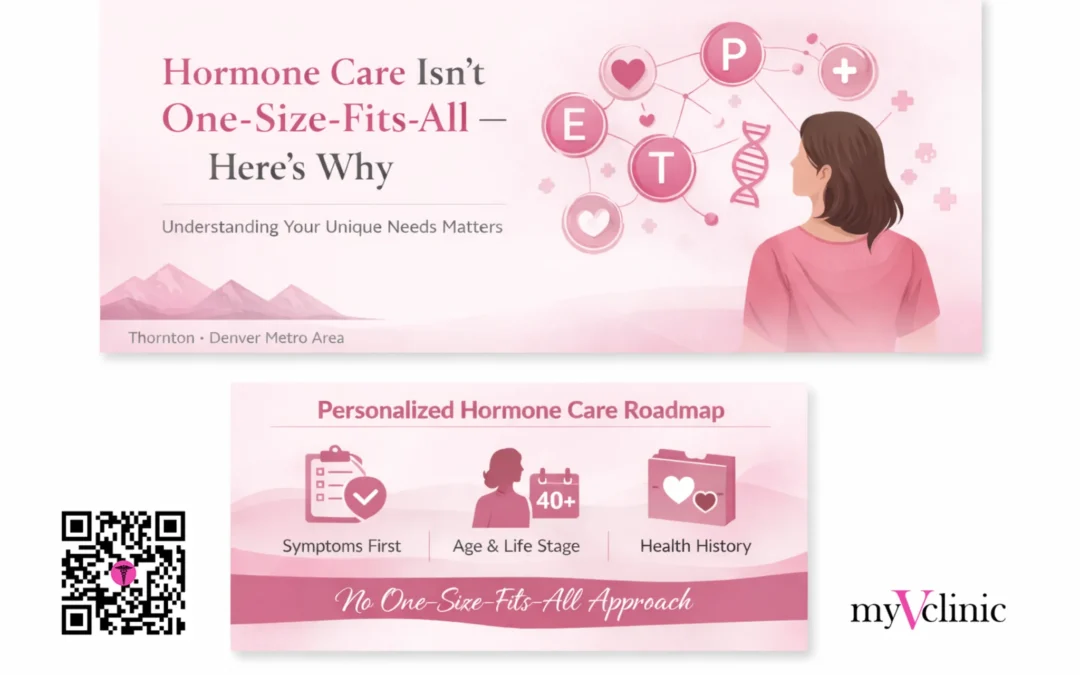
Hormone Care Isn’t One-Size-Fits-All — Here’s Why
Hormone Care
Hormone care is often talked about as if it follows a simple formula. One lab test. One prescription. One solution. But real hormone health doesn’t work that way — especially for women navigating different life stages, stress levels, medical histories, and symptoms.
At My V Clinic, we see this every day. Two women of the same age can walk in with completely different concerns, lab patterns, and priorities. Treating them the same would not be responsible care. That’s why hormone care cannot be one-size-fits-all — and why education, context, and individualized evaluation matter more than shortcuts.
This article explains why hormone care must be personalized, how symptoms change by age and life stage, what information is often missing or misunderstood, and how women in Thornton, CO and the surrounding Denver metro area can approach hormone care with clarity instead of confusion.
The Core Problem With “Standardized” Hormone Care
Hormones do not exist in isolation. Estrogen, progesterone, testosterone, thyroid hormones, cortisol, insulin, and others interact constantly. They are influenced by:
-
Age and reproductive stage
-
Stress and sleep quality
-
Past pregnancies or surgeries
-
Weight changes and metabolic health
-
Medications and supplements
-
Genetics and family history
When care ignores this context, symptoms are often minimized or dismissed. Women are told labs are “normal,” even when they don’t feel normal. This is one of the most common frustrations we hear.
Hormone care becomes effective when it starts with understanding the full picture, not just a single data point.
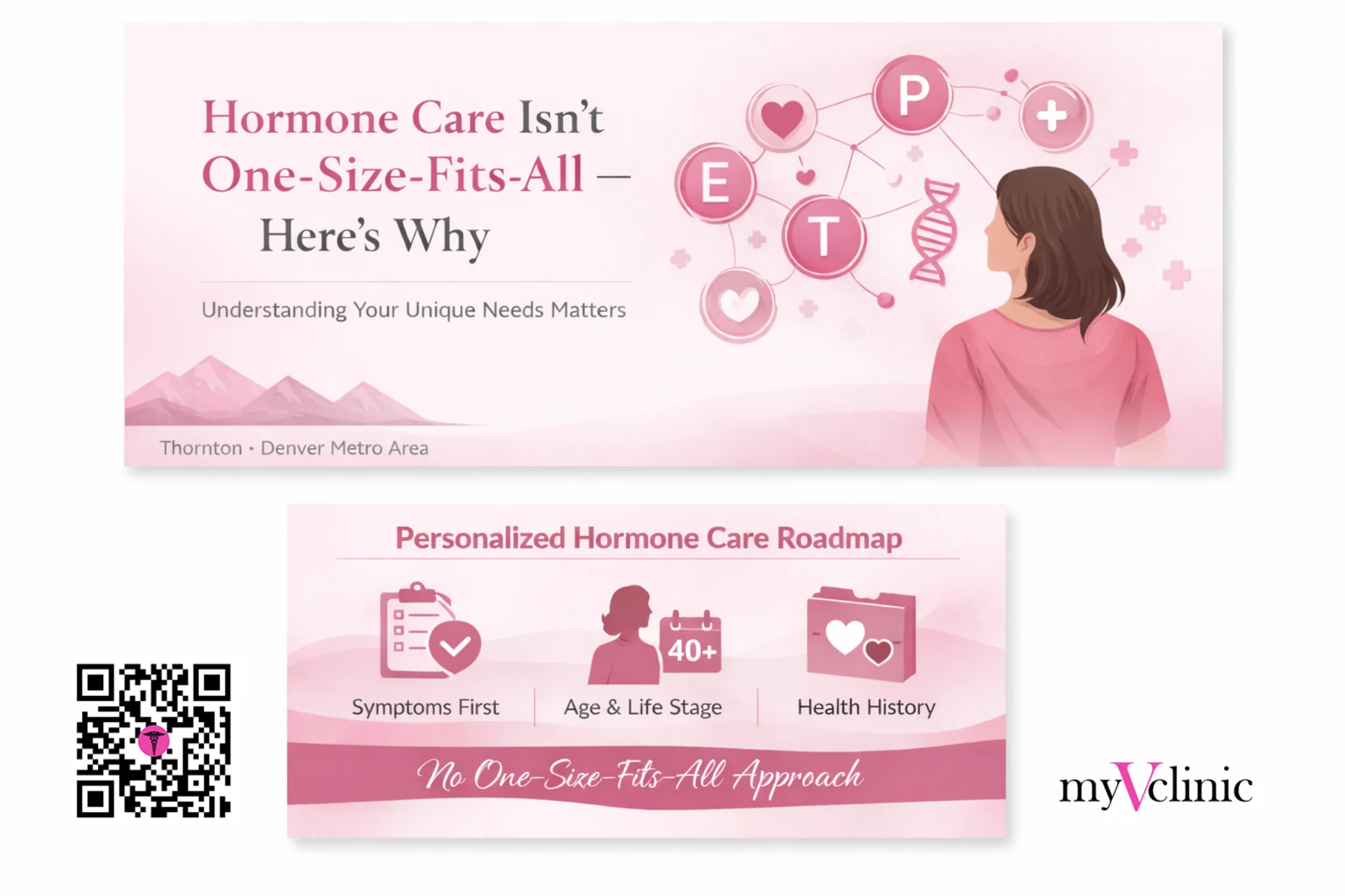
A Game-Plan Map:
How Personalized Hormone Care Actually Works
Step One: Start With Symptoms (Not Assumptions)
Symptoms are not diagnoses, but they are signals. Common hormone-related concerns include:
-
Fatigue that doesn’t improve with rest
-
Weight gain that feels unexplained
-
Mood changes or anxiety
-
Brain fog or memory issues
-
Sleep disruption
-
Low libido or changes in sexual health
-
Irregular or heavy cycles
-
Hot flashes or night sweats
Personalized hormone support, weight loss, and aesthetic care for people ready to feel like themselves again.
These symptoms can appear at different ages and for different reasons. Treating the symptom without understanding the cause is where one-size-fits-all care breaks down.
For a foundational overview of how hormones affect the body across life stages, see What Is Hormone Health on the My V Clinic site, which explains how hormone balance is evaluated as a system rather than a single number.
Step Two: Age and Life Stage Matter
Hormone needs and patterns shift over time. A 35-year-old woman and a 55-year-old woman may report similar symptoms, but the underlying drivers are often very different.
Under 40: Subtle Shifts and Early Signals
Hormone changes can begin earlier than many expect. Stress, sleep disruption, and metabolic changes often show up first. Cycles may still be regular, but symptoms can appear underneath the surface.
40s: Perimenopause and Transition
Perimenopause is marked by fluctuation, not deficiency. Estrogen and progesterone can rise and fall unpredictably, leading to symptoms that come and go. This stage is frequently misunderstood and under-treated.
For a deeper explanation of what is changing during this phase, see Perimenopause and Menopause Hormones: What’s Actually Changing.
50s and Beyond: Menopause and Post-Menopause
After menopause, hormone production shifts significantly. Symptoms may stabilize, worsen, or change form. Care at this stage focuses on symptom management, long-term health considerations, and quality of life — not chasing youth or reversing aging.
Step Three: Hormone Care Past and Present Information Both Matter
Hormone care is not just about what is happening now. Past information provides critical context, including:
-
History of hormonal birth control
-
Pregnancy and postpartum changes
-
Surgical history (including hysterectomy or oophorectomy)
-
Thyroid conditions or autoimmune disease
-
Family history of hormone-related conditions
New information — such as current symptoms, updated labs, and lifestyle changes — must be interpreted alongside that history. Ignoring either leads to incomplete care.
This is why education-first clinics emphasize evaluation over quick fixes.
Myths vs Facts: Clearing Up Common Hormone Care Confusion
Myth: “Everyone With the Same Symptoms Needs the Same Treatment”
Fact: Similar symptoms can come from different hormone pathways. Treating everyone the same increases risk and decreases effectiveness.
Myth: “If Labs Are Normal, Nothing Is Wrong”
Fact: Reference ranges are broad and do not account for individual baselines, symptom patterns, or quality-of-life impact.
Myth: “Hormone Therapy Is the Same for Everyone”
Fact: Hormone therapy is not a single approach. Decisions depend on age, symptoms, health history, and goals.
Myth: “Hormones Are Only a Menopause Issue”
Fact: Hormonal shifts can occur well before menopause and continue long after.
For women seeking structured, individualized guidance, Hormone Therapy Options and Safety Basics explains how decisions are evaluated responsibly and conservatively.
Why Location and Lifestyle Matter Too
Women in Thornton, CO and the greater Denver metro area face unique environmental and lifestyle factors that can influence hormone health, including:
-
High altitude and sleep quality
-
Seasonal light changes affecting circadian rhythm
-
High stress workloads and commuting patterns
-
Active lifestyles paired with under-recovery
Personalized care considers these realities. Hormone health does not happen in a vacuum — it happens in real life.
Where My V Clinic Fits In
My V Clinic takes an education-first, individualized approach to hormone care. The goal is not to promise outcomes or push protocols. The goal is to help women understand what is happening in their bodies so they can make informed decisions about care.
This includes:
-
Symptom-driven conversations
-
Context-aware evaluation
-
Clear explanations of options and limitations
-
Ongoing reassessment as life changes
If you’re exploring menopause-focused support, Menopause Care and Symptom Support outlines how care evolves across stages rather than following a fixed template.
The Takeaway: Personalized Care Is Safer Care
Hormone care works best when it respects individuality. Age, symptoms, history, and lifestyle all matter. When care is rushed or standardized, important signals are missed. When care is thoughtful and personalized, women gain clarity — even when answers are not immediate.
Hormone care isn’t one-size-fits-all because people aren’t one-size-fits-all.
This content is for educational purposes only and does not constitute medical advice. It does not diagnose, treat, cure, or prevent any condition. Always consult a qualified healthcare professional regarding symptoms, medications, or treatment decisions.
Related Reading
This content is for educational purposes only and does not constitute medical advice. It does not diagnose, treat, cure, or prevent any condition. Always consult a qualified healthcare professional regarding symptoms, medications, or treatment decisions.