

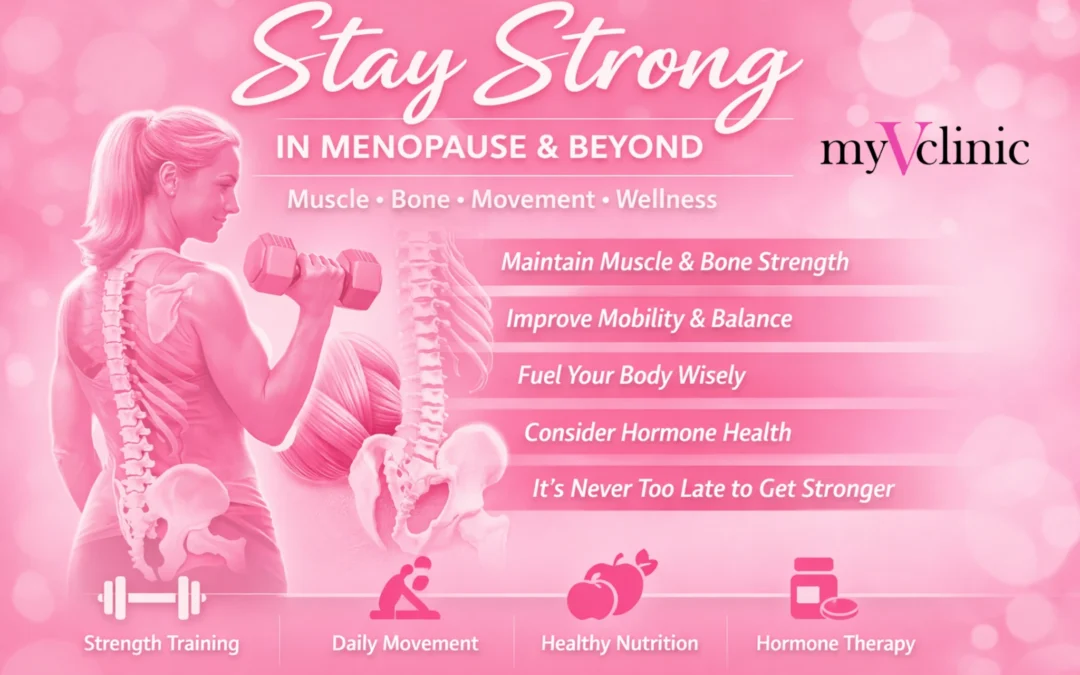
Stay Strong in Menopause & Beyond
Menopause – Why Muscle, Bone, &
Daily Movement Matter More Than Ever
If this is your first time hearing this, here’s the short version up front: menopause is not just about hot flashes, sleep problems, or mood changes. It’s also a muscle, bone, and joint transition—and for many women, this part shows up first and hits the hardest.
Women often describe it the same way:
“I wake up sore for no reason.”
“My joints hurt, but nothing shows on imaging.”
“I feel weak, stiff, or inflamed all the time.”
“I don’t feel like myself anymore.”
And too often, they’re told it’s just aging, stress, or something they need to push through.
At My V Clinic, we see something different. What many women experience during perimenopause and menopause is a hormone-driven shift in how their body maintains muscle, protects bone, and manages inflammation. When estrogen begins to fluctuate—and later decline—the systems that kept you strong and resilient quietly lose support.
This doesn’t mean your body is broken.
It means your body’s rules have changed.
The good news? Strength, mobility, and bone health are not lost causes. With the right understanding and consistent support, women can stay strong, capable, and confident well beyond menopause.
This guide breaks down what’s really happening, why it matters, and what actually helps—without hype, shame, or unrealistic promises.
The Hidden Side of Menopause: Muscle, Bone, and Joint Changes
Most menopause conversations focus on symptoms you feel right away: hot flashes, night sweats, sleep disruption, and brain fog. What often goes unexplained are the changes happening beneath the surface.
As estrogen declines, several things begin to occur:
-
Muscle protein synthesis becomes less efficient
-
Bone remodeling shifts toward breakdown rather than rebuilding
-
Inflammation becomes easier to trigger and harder to resolve
-
Recovery from exercise, injury, or stress slows
-
Tendons, ligaments, and joints lose some of their protective elasticity
Many women experience widespread joint pain or stiffness without any clear injury, often described as [perimenopause-related muscle and joint pain] that does not show up on standard imaging.
What makes this phase so unsettling is that imaging often looks “normal.” X-rays don’t explain the pain. MRIs don’t show damage. Blood work may come back “fine.” Meanwhile, the woman sitting across from the provider feels like her body has turned against her.
This disconnect is one reason women are so often dismissed.
Why Estrogen Matters for Strength and Stability
Estrogen plays a direct role in preserving bone density, supporting muscle repair, regulating inflammation, and maintaining tendon and ligament resilience.
Understanding [how estrogen supports muscle and bone health] helps explain why these changes feel so sudden and destabilizing during midlife.
When estrogen fluctuates during perimenopause—or drops after menopause—these systems lose a key regulator.
Personalized hormone support, weight loss, and aesthetic care for people ready to feel like themselves again.
Over time, this can lead to loss of lean muscle mass, increased joint pain and stiffness, accelerated bone density loss, greater injury risk, and reduced confidence in movement.
This doesn’t happen overnight. It happens quietly, gradually, and often without explanation—until something like a frozen shoulder, hip pain, or stress fracture forces attention.
Bone Density Loss: The Silent Risk
Bone loss is one of the most underestimated menopause-related risks because it is silent—until it isn’t.
Women can lose a significant percentage of bone density in the years surrounding menopause. Unlike muscle loss, you don’t feel bone thinning as it happens. The first sign is often a fracture.
Learning about [bone density changes around menopause] allows women to act earlier, before fractures or irreversible loss occur.
Hip fractures, in particular, are life-altering events. Recovery is difficult, independence can be lost, and long-term health outcomes often decline after a major fracture.
This is why bone health is not a “later” issue. It is a midlife issue.
Strength Training Isn’t Optional After Menopause
One of the biggest myths women are taught is that lifting weights is dangerous, unnecessary, or “too much” as we age. In reality, evidence consistently shows that [strength training after menopause] is one of the most effective ways to preserve muscle, protect bone, and reduce fall risk.
Resistance training helps preserve and rebuild lean muscle, stimulate bone remodeling, improve balance and coordination, improve insulin sensitivity, and reduce chronic inflammation.
This doesn’t require extreme workouts or punishing routines. It means progressive, intentional resistance—using weights, bands, or bodyweight—to signal to the body that muscle and bone are still needed.
Walking remains excellent for cardiovascular health and mobility, but on its own it does not provide enough stimulus to maintain muscle mass.
Mobility Matters as Much as Strength
Strength without mobility leads to stiffness. Mobility without strength leads to instability.
Prioritizing [daily movement and mobility during menopause] helps reduce stiffness while protecting joints from injury.
Standing and sitting regularly, gentle joint mobility work, supportive stretching, and frequent low-intensity movement throughout the day all help counteract inflammation and tissue sensitivity that can increase during menopause.
Long periods of sitting signal the body to conserve energy and tissue. Regular movement reminds the body that strength, coordination, and resilience are still required.
Nutrition: Fueling Strength, Not Inflammation
Menopause changes how the body responds to food—especially sugar and refined carbohydrates.
Many women notice that foods they once tolerated now leave them feeling inflamed, achy, fatigued, bloated, or mentally foggy.
Strategic [nutrition to support muscle and joint health] focuses on adequate protein for muscle repair, fiber-rich carbohydrates to stabilize blood sugar, healthy fats to support hormone signaling, and consistent meals to reduce metabolic stress.
This is not about restriction or perfection. It’s about fueling repair rather than inflammation.
Supplements: What Helps and What’s Overstated
Some supplements can be supportive, but they are not substitutes for movement, nutrition, or hormone balance.
Vitamin D is essential for bone health and immune function and should be guided by testing. Magnesium supports muscle function and recovery. Vitamin K2 helps direct calcium into bone rather than soft tissue.
Calcium supplementation has mixed evidence and should be individualized.
Collagen supplements are popular. Research is mixed, but they are generally safe. Some women report improved joint comfort; others notice no change.
Supplements should support a foundation—not replace it.
Hormone Therapy and Musculoskeletal Health
Hormone therapy is not just about symptom relief. For some women, understanding the relationship between [hormone therapy and musculoskeletal health] helps clarify why joint pain, stiffness, and bone loss may improve with appropriate treatment.
Low-dose estrogen has been shown to reduce joint pain, slow bone density loss, and support tissue resilience.
Hormone therapy is not one-size-fits-all. Decisions are individualized based on health history, risk factors, and goals. For women who cannot or choose not to use hormone therapy, lifestyle interventions become even more important.
It’s Never Too Late to Get Stronger
One of the most damaging beliefs women carry is that strength is something you either build early—or lose forever.
That isn’t true.
Muscle responds to training at any age. Bone responds to mechanical load at any age. The body adapts when given the right signals.
The goal is not perfection.
The goal is capacity—the ability to move, lift, balance, and live without fear.
Staying strong in menopause and beyond is not about chasing youth. It’s about protecting independence, confidence, and quality of life.
The Bigger Picture: Strength as Self-Respect
Strength is not vanity.
Movement is not punishment.
Caring for your body is not selfish.
For many women, menopause is the first time they are forced to listen to their body instead of override it. That moment—while uncomfortable—can become a turning point.
At My V Clinic, we believe midlife can be a powerful phase when women reclaim strength, agency, and clarity—not lose them.
This content is for educational purposes only and does not constitute medical advice. It does not diagnose, treat, cure, or prevent any condition. Always consult a qualified healthcare professional regarding symptoms, medications, or treatment decisions.
FAQs
1) Why do my joints and muscles suddenly ache in perimenopause if my labs or imaging look “normal”?
Many women notice new stiffness, soreness, or “whole-body” aches as hormones begin to fluctuate in perimenopause, even when X-rays or MRIs don’t show structural damage. This can reflect shifting inflammation, tissue recovery, and how estrogen supports connective tissue over time. If you want a plain-English overview of the transition itself, start here: Perimenopause and Menopause Hormones.
2) Is it true that bone loss speeds up around menopause?
Yes. Bone density can decline more quickly during the menopause transition and early postmenopause. The Endocrine Society explains menopause and bone loss, and the National Institute on Aging (NIA) notes bone loss can accelerate at menopause.
3) When should I think about getting a bone density (DEXA) scan?
Many guidelines recommend routine screening later in life, but earlier screening can be appropriate if you have risk factors (for example: prior fracture, long-term steroid use, smoking history, strong family history, or a smaller frame). A clinician can help you decide what’s right for you, based on your history and goals. For background on osteoporosis risk factors, see NIAMS: Osteoporosis.
4) What types of exercise help protect bone during and after menopause?
Bone responds to mechanical load. In practical terms, that usually means a combination of resistance training and weight-bearing activity. The NIA exercise guidance is a good starting point for safe movement habits, and the American Academy of Orthopaedic Surgeons (AAOS) menopause bone and joint tips also highlights the value of strength and weight-bearing movement.
5) Does walking count as “enough,” or do I need strength training too?
Walking is excellent for cardiovascular health, mobility, and daily function, but it may not provide enough stimulus by itself to preserve muscle mass and strength as you age. Many women do best with walking plus some form of resistance training (weights, bands, machines, or bodyweight). For practical, safe ways to build movement into your week, see Exercise and Physical Activity (NIA).
6) Why does long sitting make me feel stiff, and what actually helps?
Long periods of sitting can reduce joint motion, decrease circulation to working tissues, and make stiffness feel worse—especially when recovery and inflammation control are more sensitive during midlife. Short “movement breaks” throughout the day can help (standing, a brief walk, gentle mobility). The NIA also includes easy ways to add activity safely in daily life: NIA: Exercise and physical activity.
7) Can hormone therapy help with joint pain or bone loss?
For some women, hormone therapy may improve symptoms like joint discomfort and can help slow bone loss, but it is not one-size-fits-all and must be individualized based on your health history, risk factors, and goals. For evidence-based context on bone changes during the menopause transition, see this review article: Bone Health during the Menopause Transition and Beyond (PMC).
8) What if I can’t use hormone therapy or I’m starting later in life?
Even without hormone therapy, your body can still respond to the right “inputs” over time—especially strength training, daily movement, protein-forward nutrition, and bone-supportive habits. It’s never “too late” to benefit from movement, but the plan should match your medical history and current capacity. If you’re trying to understand where you are in the transition and what to track, this is a helpful starting point: Perimenopause Myth or Fact.
Related Reading
- Menopause Care and Symptom Support
- Hormone Therapy Options and Safety Basics
- Sexual Wellness After 40
- GSM: Vaginal and Urinary Symptoms Explained
This content is for educational purposes only and does not constitute medical advice. It does not diagnose, treat, cure, or prevent any condition. Always consult a qualified healthcare professional regarding symptoms, medications, or treatment decisions.