

Women and Testosterone Myth or Fact
Women & Testosterone
If you are between 35 and 55 and living here in Thornton, there is a decent chance you have felt a shift you cannot fully explain. Your workouts do not give you the same results. Your mental sharpness feels dulled. Your motivation is inconsistent. Your desire may be different. You might not even use the word hormones yet. You just know something feels off.
Women & Testosterone Facts
Let’s get very clear about what this conversation is and what it is not.
This is not a trendy social media pitch about turning women into bodybuilders. This is not a promise that one hormone fixes everything. And this is not about chasing numbers on a lab sheet.
This is about understanding that testosterone is present in every female body and that it plays a meaningful role in muscle physiology, metabolic health, brain function, and sexual wellbeing. Most women were never taught this. In medical training for decades, hormones were labeled and gendered in ways that oversimplified biology. Estrogen was “female.” Testosterone was “male.” That framework left a gap in midlife care.
If you are reading this because you feel tired, less driven, less strong, or less mentally sharp than you used to, this article will unpack what testosterone actually does, how it shifts during perimenopause and menopause, and how to approach the topic responsibly. By the end, you will understand when testosterone might be relevant, when it might not be, and how a structured hormone consultation should work inside a guided wellness model.
You are not broken. Your body is transitioning. And our role at My V Clinic is to help you interpret that transition with clarity instead of confusion.
The expanded introduction matters because oversimplification is where most harm begins. Hormones are not light switches. They operate in networks. Ovarian function shifts during perimenopause. Estrogen fluctuates unpredictably. Progesterone often declines earlier. Testosterone may decrease as well, but patterns vary widely from woman to woman.
The ovaries produce testosterone directly. Some of that testosterone converts into estrogen through the aromatase enzyme pathway. When ovarian production becomes irregular, that entire cascade shifts. Add sleep disruption, stress load, and metabolic changes, and symptoms can layer quickly.
Dr. Kelly Casperson, MD, a board certified urologist specializing in female sexual medicine, has publicly explained that testosterone is not simply about libido. It influences cognitive clarity, lean muscle mass, and overall vitality in women. She emphasizes that labeling hormones as male versus female has delayed accurate conversations in midlife care.
https://kellycaspersonmd.com
The Endocrine Society has published clinical guidance stating that testosterone therapy for women should aim for physiologic premenopausal ranges, not supraphysiologic dosing. That distinction matters. More is not better. Safe is better.
https://www.endocrine.org
When women say, “I do not feel like myself,” that statement deserves structured evaluation. Testosterone may be part of the conversation. It may not. But it should not be ignored or dismissed out of outdated assumptions.
The Surface Problem & Myths
Women often present with symptoms that sound simple but are deeply frustrating:
• Reduced ability to build or maintain muscle
• Increased abdominal fat despite consistent exercise
• Lower motivation or drive
• Brain fog or slower recall
• Decreased sexual desire
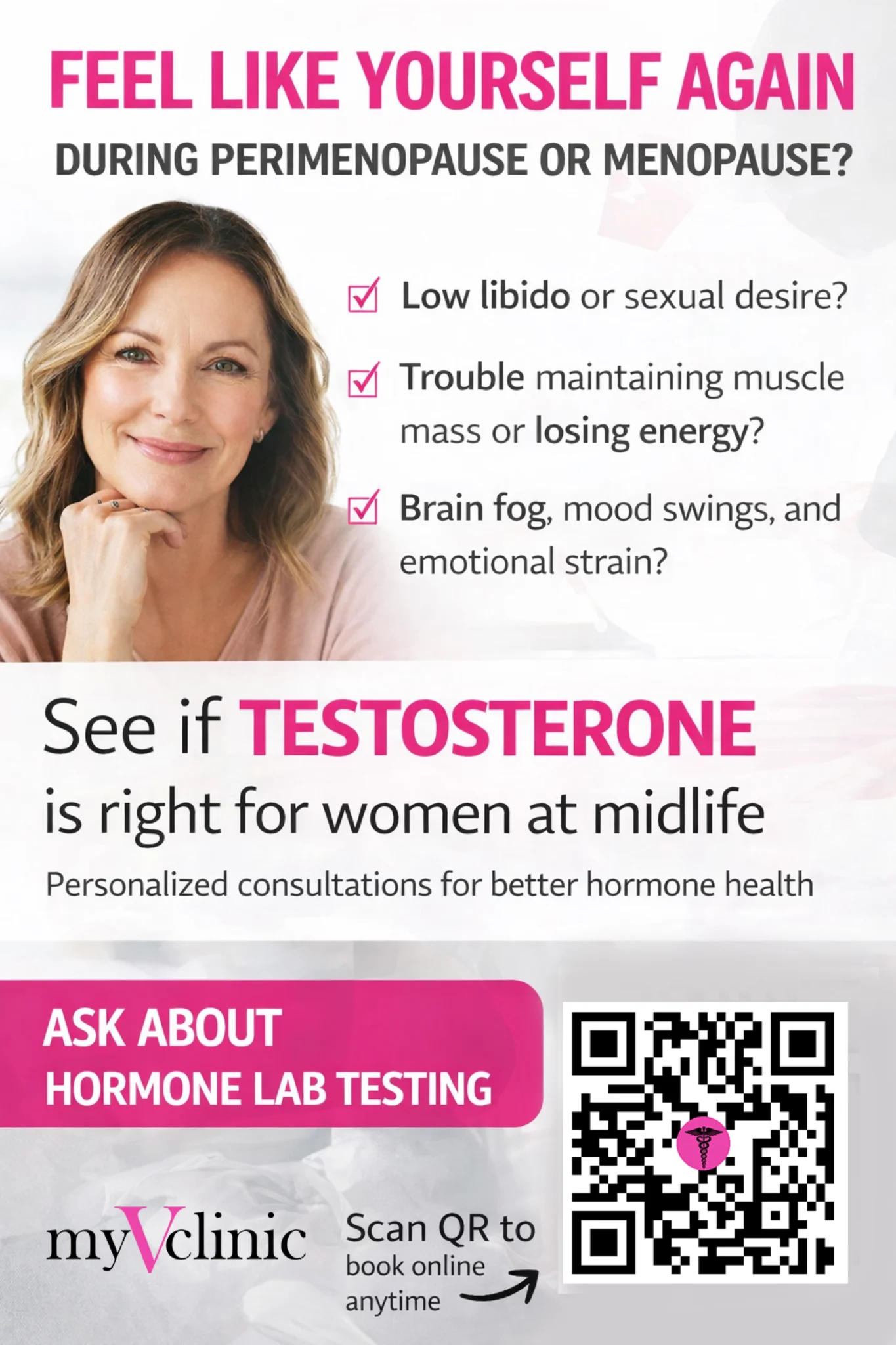
These symptoms are real. But they are not self diagnosing.
Testosterone decline can contribute to these changes. So can thyroid dysfunction. So can insulin resistance. So can chronic stress. So can poor sleep.
The first mistake midlife women are often told is “this is normal aging.” The second mistake is self prescribing based on a social media clip. Both extremes miss nuance.
Personalized hormone support, weight loss, and aesthetic care for people ready to feel like themselves again.
The Deeper Biological Shift
During perimenopause, estrogen production becomes erratic. Progesterone often declines earlier because ovulation becomes inconsistent. Testosterone production from the ovaries may also decrease, though adrenal contribution varies by individual.
Androgen receptors exist in brain tissue, skeletal muscle, and genital tissue. This is why testosterone can influence cognitive clarity, muscle strength, and sexual sensation.
The North American Menopause Society emphasizes that hormone therapy decisions must be individualized and based on symptom burden, medical history, and risk assessment.
https://www.menopause.org
There is no universal “normal” testosterone number that fits every woman. Levels fluctuate during the menstrual cycle and vary by age. Treatment should be symptom guided with labs used for safety monitoring, not ego driven target chasing.
Excess dosing can cause acne, scalp hair thinning, or voice changes. Responsible care prevents that through conservative titration and follow up testing.
The Solution Framework
At My V Clinic, testosterone is not automatically prescribed. It is evaluated within a full hormone consultation that includes:
• Detailed symptom mapping
• Comprehensive lab evaluation
• Thyroid and metabolic review
• Cardiovascular risk assessment
• Sleep and stress evaluation
If testosterone support is appropriate, dosing is conservative. Follow up labs confirm physiologic ranges. Adjustments are gradual.
This is educational positioning, not a guarantee of outcomes. Hormone care is individualized.
Proper Execution
Generic advice fails midlife women because it ignores physiology.
You cannot out exercise declining ovarian function. You cannot meditate away muscle loss entirely. You cannot shame yourself into hormonal stability.
Many women between 40 and 55 are juggling careers, caregiving, and personal transitions simultaneously. Hormonal shifts layered onto that load can amplify fatigue and cognitive strain.
Guided care matters because it separates hormonal causes from lifestyle amplification. It explains mechanisms instead of dismissing symptoms.
Guide Positioning
My V Clinic was built to serve midlife women in Thornton who felt unheard. Since [Insert Year], our focus has been structured hormone health consultations and personalized wellness programs for women 35 to 55.
We do not position ourselves as the hero. You are the one living this transition.
Our role is to interpret lab data, explain physiology clearly, and guide safe decisions grounded in evidence and experience.
Thornton women deserve hormone conversations that respect both science and quality of life.
Expert Authority Integration
Dr. Kelly Casperson, MD
Board Certified Urologist, Female Sexual Medicine Specialist
https://kellycaspersonmd.com
The Endocrine Society
Clinical Practice Guidelines on Testosterone Therapy
https://www.endocrine.org
The North American Menopause Society
Menopause Hormone Therapy Position Statements
https://www.menopause.org
These sources reinforce individualized, physiologic dosing and evidence based monitoring.
FAQs
Is testosterone only for libido?
No. It may influence muscle mass, mood, cognitive clarity, and sexual desire.
Do all women need testosterone?
No. Many women improve with estrogen support alone. Evaluation determines appropriateness.
Is testosterone safe?
When prescribed in physiologic doses and monitored properly, research supports its safety in appropriate candidates.
How long before I notice results?
Some women notice changes within three months. Others require longer assessment periods.
Will testosterone cause hair loss?
High levels can contribute to hair thinning. Conservative dosing minimizes this risk.
Can I take testosterone without estrogen?
In certain cases, yes. Individual assessment determines structure.
Is testing required?
Yes. Labs help ensure safe dosing and rule out excessive levels.
Does stress mimic low testosterone?
Absolutely. Sleep deprivation and chronic stress can produce similar symptoms.
Is this preventative medicine?
Currently, testosterone is not universally recommended for prevention in asymptomatic women.
What if my labs are normal but I feel off?
Normal ranges are broad. Symptom context matters. Comprehensive review is essential.
Sources
- Dr. Kelly Casperson MD – Female Sexual Medicine Education
- Endocrine Society Clinical Practice Guidelines
- North American Menopause Society Position Statements
This content is for educational purposes only and does not constitute medical advice. It does not diagnose, treat, cure, or prevent any condition. Always consult a qualified healthcare professional regarding symptoms, medications, or treatment decisions.
Related Reading
This content is for educational purposes only and does not constitute medical advice. It does not diagnose, treat, cure, or prevent any condition. Always consult a qualified healthcare professional regarding symptoms, medications, or treatment decisions.