

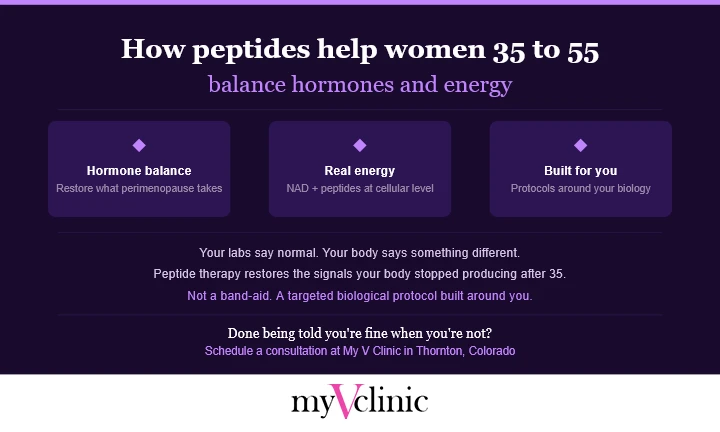
How peptides help women 35 to 55 balance hormones and energy
Peptides, Hormones and Energy
You know that feeling when you wake up already tired? Before coffee. Before the day even starts. And no matter how early you went to bed, it doesn’t matter. You’re still dragging.
That’s not just stress. Something is actually shifting inside your body, and most women don’t find out what it is until they’ve spent years being told their labs look fine.
After 35, your body starts producing fewer of the signaling molecules it needs to regulate energy, hormones, immune function, and cellular repair. These molecules are called peptides. When they drop, you feel it. You just don’t always know that’s what you’re feeling.
The fatigue hits first. Then the weight that won’t budge. Then the mood shifts that seem to come out of nowhere. You start wondering if this is just what your 40s feel like. It isn’t. Or at least it doesn’t have to be.
By the time you finish reading this you’ll understand why peptides matter specifically for women in this stage of life, what the research says, and what getting started looks like at My V Clinic in Thornton.
Your body stopped getting the signals it needs
Most women who come in have already seen their regular doctor. Had bloodwork done. Been told everything looks normal. And left that appointment more confused than when they walked in.
Standard bloodwork catches some things but misses a lot. It doesn’t show what’s happening at the mitochondrial level. It doesn’t capture the gradual decline in growth hormone that starts in your mid 30s. It doesn’t measure the low-grade inflammation building quietly in the background. By the time a conventional lab flags something, it’s been going on for a while.
That gap is where peptide therapy lives.
What’s actually happening inside your body
Your body runs on signals. Every process, hormone production, immune response, energy metabolism, depends on the right molecules showing up and telling your cells what to do. Peptides are part of that system.
A peptide is a chain of 40 or fewer amino acids. Short, specific, targeted. Each one has a job. Some tell your pituitary to release more growth hormone. Others reduce inflammation. Others support the mitochondria inside your cells that produce the energy you run on every day.
Dr. Craig Koniver, founder of Koniver Wellness in Charleston, South Carolina and a physician specializing in health and human performance medicine, has worked with peptide therapy longer than most practitioners in this space. His clinical observation is that women tend to respond strongly, often more quickly than men. Part of that is because women seek answers earlier rather than waiting until something completely breaks down. More at koniverwellness.com.
CJC-1295 signals the pituitary to release more natural growth hormone, supporting lean muscle, fat metabolism, sleep, and energy. Ipamorelin works alongside it without raising cortisol. Together they restore the hormonal signaling your body relied on in your late 20s.
Personalized hormone support, weight loss, and aesthetic care for people ready to feel like themselves again.
BPC-157 supports tissue repair and reduces inflammation. Women dealing with joint pain, gut issues, or slow recovery notice this one first. TB-500 supports collagen and structural healing. Thymosin Alpha-1 regulates immune function and clears the chronic low-grade inflammation that drains energy without you ever finding a single cause.
NAD therapy works alongside peptide protocols to address mitochondrial energy directly. NAD is a vitamin B3 derivative that fuels every cell in your body. Research published through the National Institutes of Health documents the relationship between declining NAD levels and the fatigue, brain fog, and metabolic slowdown that become more common after 40. Intravenous NAD delivers it straight into your bloodstream. Most women report better mood, deeper sleep, faster recovery, and more consistent energy within a few weeks.
You’re not masking the fatigue. You’re restoring the machinery that produces real energy.
What this looks like at My V Clinic
Every woman who comes in gets a real conversation first. We talk about what you’re experiencing, what you’ve already tried, what your labs show, and what you actually want to feel like. Then we build something specific to you.
Peptide protocols typically involve small subcutaneous injections you do at home once or twice a day. The needles are fine. Most women say it’s easier than they expected. We walk you through everything and we’re available when questions come up.
Most women notice shifts within two to three weeks. Energy first. Then sleep. Then inflammation starts to ease. Body composition usually follows after six to eight weeks. These early changes are real. Your body is responding to biological signals it wasn’t getting before.
Why this works when other things haven’t
Most women who find their way to peptide therapy have already tried other things. Diets. Hormone replacement therapy. Supplements. Some of it helped a little. None of it fixed the actual problem.
Because the actual problem is biological. You can’t exercise your way out of insufficient growth hormone. You can’t sleep your way out of systemic inflammation. You can’t take a B12 shot and fix mitochondrial dysfunction. These are real physiological deficits that need targeted interventions.
When the right protocol meets a woman whose body is ready to respond, the shift is not subtle. It’s the difference between managing symptoms and actually feeling well again.
Why My V Clinic in Thornton
My V Clinic opened in Thornton in 2025 with one focus: women’s hormone health and wellness. Not as a side service. This is what we do.
The Front Range has a growing population of women in exactly this demographic who are done accepting exhaustion as a life stage. Our consultations are thorough. Our protocols are individualized. Our follow-up is real. We measure success the only way that matters, by how you actually feel.
If you’ve been told your labs are normal while feeling anything but, a conversation with us is worth having.
Frequently asked questions
What exactly is a peptide and how is it different from a hormone?
A peptide is a short chain of amino acids. Hormones are messengers produced by glands like the pituitary or thyroid. Peptides work by signaling those glands to produce more of their own hormones rather than replacing them from outside. Your body stays in charge of its own production.
Why do women between 35 and 55 benefit most from peptide therapy?
This is when growth hormone declines most significantly, perimenopause begins affecting estrogen and progesterone, and mitochondrial energy output starts dropping. Peptide therapy addresses all three simultaneously in ways that conventional HRT alone doesn’t.
How is peptide therapy administered?
Small subcutaneous injections, similar to insulin injections for diabetics. The needles are very fine. Most women find it much easier than they expected. We provide full instruction for self-administration at home.
How long before I notice results?
Most women notice changes within two to four weeks. Energy and sleep quality shift first. Body composition changes typically follow after six to eight weeks of consistent protocol.
Are there side effects?
Peptides have a strong safety profile. Most reported effects are mild and temporary, slight injection site irritation or occasional headache. Serious adverse effects are rare under proper clinical supervision.
Can peptide therapy be combined with hormone replacement therapy?
Yes. They address different biological systems and work well together. Many women find peptides fill the gaps HRT alone leaves open, particularly around energy, immune function, and cellular repair.
What is NAD therapy and how does it relate to peptides?
NAD fuels your mitochondria. Intravenous NAD therapy restores cellular energy production at a foundational level and works well alongside peptide protocols. Together they address both the signaling deficits and the energy production deficits driving your fatigue.
What happened with FDA regulations on peptides?
Starting in 2025 the FDA tightened restrictions on compounded peptides. My V Clinic stays current with all regulatory changes and works only within compliant protocols. We’re always transparent about what’s available and what alternatives exist.
How is My V Clinic different from a standard hormone clinic?
We focus specifically on women’s hormone health with clinical depth that goes beyond standard HRT. We look at the full picture, cellular energy, inflammation, immune function, and hormone signaling, not just isolated symptoms.
How do I get started?
Start with a consultation. We review your health history, symptoms, and goals, order targeted lab work, and build a protocol specific to your biology. Contact My V Clinic in Thornton to schedule.
Is peptide therapy covered by insurance?
Most protocols are not covered by standard insurance. We provide transparent pricing during your consultation.
Can peptide therapy help with weight loss?
Yes. CJC-1295 and Ipamorelin support fat metabolism and lean muscle maintenance, which directly affects body composition. We discuss all available options during your consultation.
This content is for educational purposes only and does not constitute medical advice. It does not diagnose, treat, cure, or prevent any condition. Always consult a qualified healthcare professional regarding symptoms, medications, or treatment decisions.
Related Reading
- Menopause Care and Symptom Support
- Hormone Therapy Options and Safety Basics
- Sexual Wellness After 40
- GSM: Vaginal and Urinary Symptoms Explained
This content is for educational purposes only and does not constitute medical advice. It does not diagnose, treat, cure, or prevent any condition. Always consult a qualified healthcare professional regarding symptoms, medications, or treatment decisions.