

Menopause Relief Guide|Clear Solutions for Hormonal Changes
Menopause Relief Guide
Menopause does not ask for permission. It shows up, changes how your body feels, and leaves you trying to figure out what just happened. Dryness. Irritation. Pain. Urinary urgency. A shift in intimacy. If this is your first time hearing this, these are not separate issues. They are connected.
Most women between 35 and 55 are not given a real explanation. They are handed surface level advice and told it is normal. But normal does not mean you have to live with it. There is a reason this is happening, and there is a way to address it.
Menopause Relief Guide
If you are dealing with symptoms that feel new, frustrating, or confusing, you are not alone. What you are experiencing is part of a larger shift happening inside the body. The problem is not that there are no solutions. The problem is that most women are never shown what actually works.
This guide is built to change that. We are going to walk through what is happening, why it is happening, and what real relief looks like. Not quick fixes. Not temporary patches. Real solutions that address the root cause.
By the end of this, you will understand how hormone changes affect tissue health, why symptoms like dryness and urinary urgency show up together, and how targeted treatments like vaginal estrogen therapy can help restore comfort and function.
SECTION 1
The Surface Problem
Before you can fix something, you have to recognize what is actually happening. Most women do not experience just one symptom. They experience a pattern. The problem is that no one connects those dots early enough, so it feels like multiple unrelated issues instead of one underlying cause.
Common symptoms include:
- Vaginal dryness that does not go away
- Burning or irritation
- Pain during intimacy
- Reduced natural lubrication
- Urinary urgency or frequency
- Recurrent urinary tract infections
- Decreased arousal or sensation
At this stage, most women try to solve the problem at the surface level. More water. Over the counter products. Lubricants. These can help temporarily, but they do not hold.
That is because the issue is not sitting on the surface.
SECTION 2
The Deeper Biological Shift
Recognizing the symptoms is the first step, but stopping there keeps you stuck in a cycle of temporary fixes. If you do not understand what is driving those symptoms, you are left guessing. This is where we need to step deeper and look at what is actually changing inside the body.
According to Rachel Rubin, the tissue of the vulva and vagina is directly influenced by estrogen. When estrogen declines, the structure and function of that tissue changes.
Personalized hormone support, weight loss, and aesthetic care for people ready to feel like themselves again.
This leads to:
- Thinning of the vaginal lining
- Reduced blood flow
- Loss of elasticity
- Decreased natural lubrication
- Changes in the protective microbiome
This condition is known as:
Genitourinary Syndrome of Menopause
This is not just dryness. It is tissue breakdown driven by hormone changes.
Once you understand that, the conversation shifts. You are no longer trying to manage symptoms. You are looking to restore function.
SECTION 3
The Solution Framework
Understanding the cause gives you direction, but it does not solve the problem by itself. Once you know that hormone decline is affecting tissue health, the next step is identifying what actually restores that tissue. This is where targeted treatment matters.
According to Rachel Rubin:
“Vaginal estrogen is the single most effective therapy in our toolkit for treating GSM.”
That statement is backed by real clinical use, not theory.
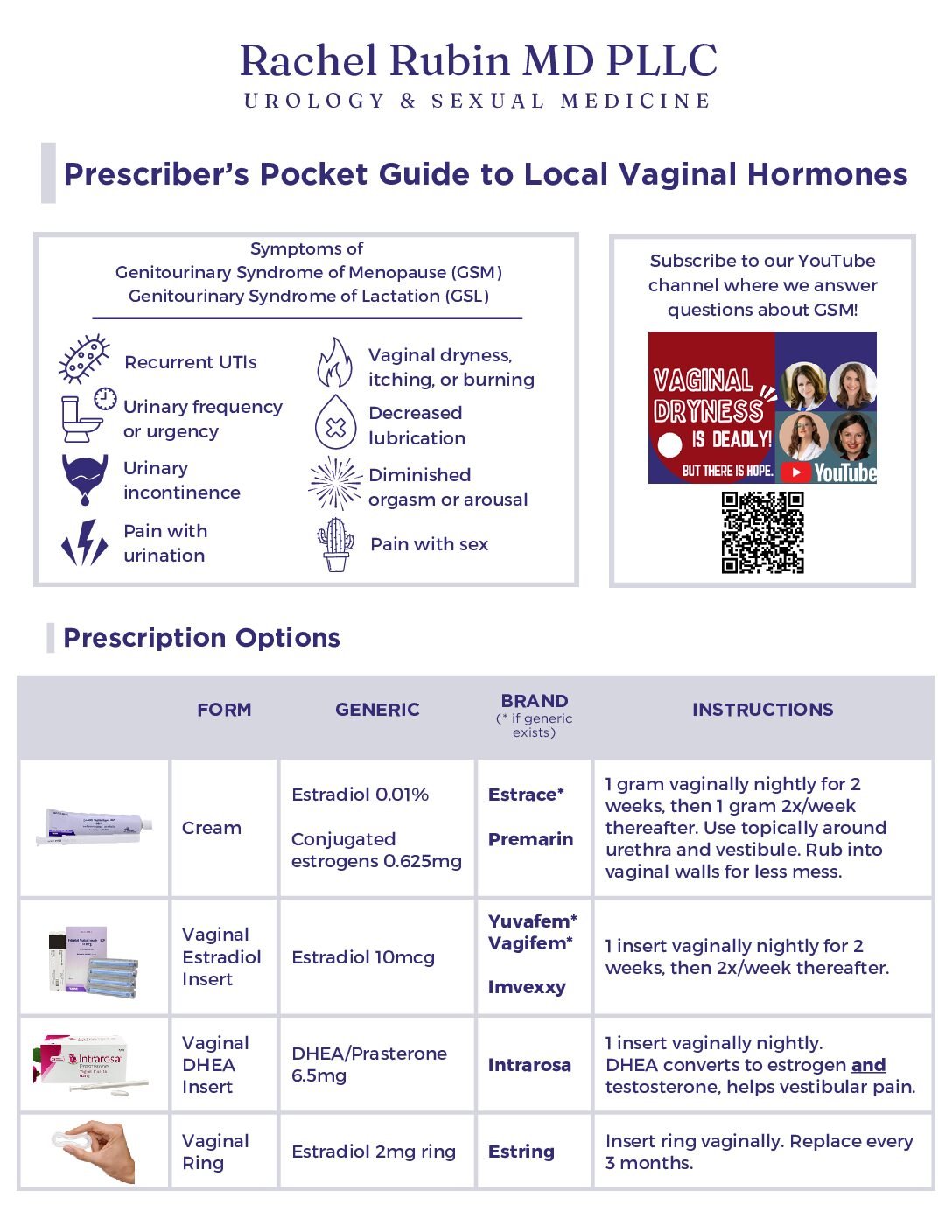
From prescribing guidance , treatment options include:
Vaginal Estrogen Creams
Applied internally and externally to support tissue directly
Typical use:
- Nightly for two weeks
- Then twice weekly
Vaginal Estradiol Inserts
Low dose, targeted delivery
Cleaner and easier to use consistently
Vaginal DHEA Inserts
Converts locally into estrogen and testosterone
Supports both tissue health and sensation
Vaginal Estrogen Rings
Placed once and replaced every three months
Provides steady, low dose support
These are not temporary fixes. They are designed to rebuild tissue from the inside out.
SECTION 4
Proper Execution
Knowing what works is one piece of the puzzle. Using it correctly is what determines whether you actually get results. This is where most women get stuck, not because solutions are unavailable, but because they are not guided through how to use them.
Fewer than 7 percent of women with GSM are prescribed vaginal estrogen. That is not a small gap. That is a system level issue.
Proper execution means:
- Choosing the right treatment type
- Following the correct schedule
- Using it consistently
- Adjusting based on your response
This is not one size fits all.
Without structure, even the right solution can fail.
SECTION 5
Guide Positioning
At this point, you understand the symptoms, the cause, and the available solutions. But information alone does not create change. What matters is how that information is applied to your specific situation. This is where guidance becomes critical.
My V Clinic is built around helping women navigate this exact phase of life.
Serving women in Thornton, Colorado, the focus is clear:
- Education that actually makes sense
- Personalized hormone support
- Clear direction without confusion
Women between 35 and 55 are often in the middle of these changes without realizing what is happening.
You are not broken.
You are not imagining it.
You just have not been given the full picture yet.
SECTION 6
Expert Authority Integration
Everything you have read here is not opinion. It is backed by specialists who study and treat these conditions every day. What ties all of this together is consistency across clinical practice.
The work of Rachel Rubin shows:
- Hormone decline affects tissue directly
- Symptoms are often overlooked
- Localized hormone therapy is highly effective
Prescribing frameworks confirm that these treatments are already being used in real medical settings.
This is established care.
The problem has never been a lack of solutions.
The problem has been awareness.
FAQs
What is the most effective menopause relief for vaginal symptoms?
Localized vaginal estrogen therapy is considered one of the most effective treatments for tissue related symptoms.
What causes vaginal dryness during menopause?
Declining estrogen levels lead to thinner, less hydrated tissue.
Is menopause relief possible without hormones?
Some options exist, but hormone based therapies address the root cause more directly.
How long does vaginal estrogen take to work?
Many women see improvement within a few weeks.
Can menopause cause urinary problems?
Yes. Hormone changes affect urinary tissue and function.
What is GSM?
Genitourinary Syndrome of Menopause is a condition affecting vaginal and urinary health due to hormone decline.
Do I need a prescription for treatment?
Yes. Most effective therapies require a prescription.
Is vaginal estrogen safe long term?
It is generally considered safe when used under proper guidance.
What is DHEA treatment?
It is a therapy that converts into estrogen and testosterone locally in tissue.
Why are these treatments not commonly discussed?
They are still under prescribed and under explained despite being widely used.
This content is for educational purposes only and does not constitute medical advice. It does not diagnose, treat, cure, or prevent any condition. Always consult a qualified healthcare professional regarding symptoms, medications, or treatment decisions.
Related Reading
- Menopause Care and Symptom Support
- Hormone Therapy Options and Safety Basics
- Sexual Wellness After 40
- GSM: Vaginal and Urinary Symptoms Explained
This content is for educational purposes only and does not constitute medical advice. It does not diagnose, treat, cure, or prevent any condition. Always consult a qualified healthcare professional regarding symptoms, medications, or treatment decisions.